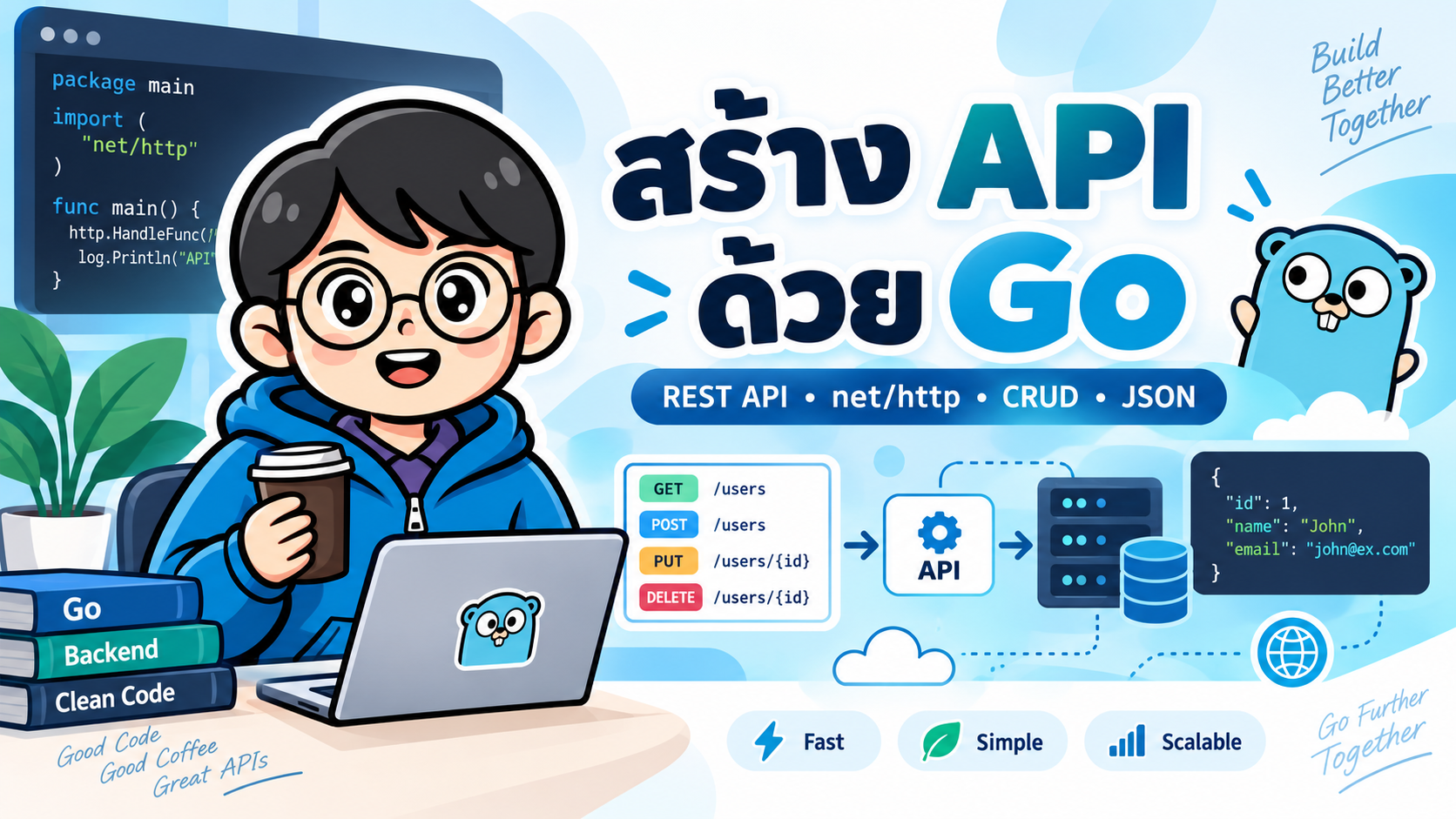
- สร้าง REST API ด้วย Go: ตั้งแต่เริ่มต้นจนถึง CRUD ด้วย net/http
- 1. ติดตั้ง Go
- 2. สร้างโปรเจกต์
- 3. ทำความเข้าใจ REST API ที่จะสร้าง
- 4. สร้าง Struct สำหรับ Product
- 5. แยก Input Model
- 6. สร้าง In-memory Store
- 7. สร้างคำสั่ง CRUD ใน Store
- 8. สร้าง Helper สำหรับ JSON Response
- 9. อ่าน Path Parameter
- 10. อ่าน JSON Request และทำ Validation
- 11. สร้าง Application
- 12. สร้าง Health Check API
- 13. GET Products
- 14. GET Product ตาม ID
- 15. POST Product
- 16. PUT Product
- 17. DELETE Product
- 18. กำหนด Routing
- 19. Middleware
- 20. Logging Middleware
- 21. Panic Recovery Middleware
- 22. CORS Middleware
- 23. รวม Middleware
- 24. สร้าง HTTP Server
- 25. Source Code ฉบับเต็ม
- 26. รัน API
- 27. ทดสอบ Health Check
- 28. ทดสอบ POST
- 29. ทดสอบ GET ทั้งหมด
- 30. ทดสอบ GET ตาม ID
- 31. ทดสอบ PUT
- 32. ทดสอบ DELETE
- 33. HTTP Status Code ที่ควรรู้
- 34. เพิ่ม Unit Test ด้วย httptest
- 35. โครงสร้างโปรเจกต์เมื่อระบบใหญ่ขึ้น
- 36. เชื่อมต่อ PostgreSQL
- 37. Environment Variable
- 38. Authentication
- 39. API Versioning
- 40. Pagination
- 41. Filtering และ Sorting
- 42. Request ID
- 43. Observability
- 44. Rate Limiting
- 45. Graceful Shutdown
- 46. Dockerize Go API
- 47. Framework จำเป็นหรือไม่?
- 48. Checklist ก่อน Deploy Production
- 49. Architecture ที่แนะนำ
- สรุป
- เอกสารอ้างอิง
#สร้าง REST API ด้วย Go: ตั้งแต่เริ่มต้นจนถึง CRUD ด้วย net/http
Go หรือ Golang เป็นภาษาที่เหมาะกับการพัฒนา Backend และ API เนื่องจากมีจุดเด่นด้านประสิทธิภาพ การใช้ทรัพยากรค่อนข้างต่ำ การทำงานแบบ Concurrent ด้วย Goroutine และมี Standard Library ที่รองรับงาน Web Server อยู่แล้ว
บทความนี้จะสาธิตการสร้าง REST API สำหรับจัดการข้อมูลสินค้า (Product) โดยใช้ net/http ซึ่งเป็น Standard Library ของ Go โดยไม่ต้องติดตั้ง Web Framework เพิ่มเติม
บทความนี้ใช้ Routing รูปแบบ
GET /api/products/{id}ซึ่งรองรับโดยhttp.ServeMuxตั้งแต่ Go 1.22 ขึ้นไป
ณ วันที่เขียนบทความ Go รุ่นเสถียรล่าสุดคือ Go 1.27.1
#สิ่งที่จะได้เรียนรู้
หลังจากจบบทความนี้ เราจะสามารถสร้าง API ที่รองรับ
| Method | Endpoint | หน้าที่ |
|---|---|---|
GET |
/health |
ตรวจสอบสถานะ Server |
GET |
/api/products |
ดึงสินค้าทั้งหมด |
GET |
/api/products/{id} |
ดึงสินค้าตาม ID |
POST |
/api/products |
เพิ่มสินค้า |
PUT |
/api/products/{id} |
แก้ไขสินค้า |
DELETE |
/api/products/{id} |
ลบสินค้า |
นอกจากนี้ยังครอบคลุม
- JSON Request/Response
- HTTP Status Code
- Input Validation
- Path Parameter
- Error Handling
- Middleware
- CORS
- Request Size Limit
- Server Timeout
- การทดสอบด้วย
curl - แนวทางแยกโครงสร้างโปรเจกต์สำหรับ Production
#1. ติดตั้ง Go
ดาวน์โหลด Go ได้จากเว็บไซต์อย่างเป็นทางการ
https://go.dev/dl/
ตรวจสอบเวอร์ชัน
go version
ตัวอย่าง
go version go1.27.1 darwin/arm64
สำหรับบทความนี้แนะนำ Go 1.22 ขึ้นไป เพราะ http.ServeMux รองรับ Method-based Routing และ Path Wildcard แล้ว
#2. สร้างโปรเจกต์
สร้างโฟลเดอร์
mkdir go-rest-api
cd go-rest-api
สร้าง Go Module
go mod init example.com/go-rest-api
จะได้ไฟล์
go.mod
โครงสร้างเริ่มต้น
go-rest-api/
├── go.mod
└── main.go
#3. ทำความเข้าใจ REST API ที่จะสร้าง
เราจะสร้างระบบ Product โดย Product หนึ่งรายการมีข้อมูลดังนี้
{
  "id": 1,
  "name": "Mechanical Keyboard",
  "price": 2490,
  "stock": 10,
  "created_at": "2026-09-15T00:00:00Z",
  "updated_at": "2026-09-15T00:00:00Z"
}
ในตัวอย่างนี้จะเก็บข้อมูลไว้ใน Memory ก่อน เพื่อให้เข้าใจ HTTP API ได้ง่าย โดยยังไม่เชื่อมต่อฐานข้อมูล
#4. สร้าง Struct สำหรับ Product
สร้างไฟล์ main.go
package main

import (
	"time"
)

type Product struct {
	ID        int64     `json:"id"`
	Name      string    `json:"name"`
	Price     float64   `json:"price"`
	Stock     int       `json:"stock"`
	CreatedAt time.Time `json:"created_at"`
	UpdatedAt time.Time `json:"updated_at"`
}
Tag เช่น
`json:"name"`
ใช้กำหนดชื่อ Field เมื่อแปลง Struct เป็น JSON
#5. แยก Input Model
ไม่ควรรับ Product ทั้ง Struct จาก Client โดยตรง เพราะ Client ไม่ควรกำหนดค่า เช่น
idcreated_atupdated_at
จึงสร้าง Input Model แยกต่างหาก
type ProductInput struct {
	Name  string  `json:"name"`
	Price float64 `json:"price"`
	Stock int     `json:"stock"`
}
#6. สร้าง In-memory Store
ตัวอย่างนี้ใช้ map เป็น Data Store
type Store struct {
	mu       sync.RWMutex
	products map[int64]Product
	nextID   int64
}

func NewStore() *Store {
	return &Store{
		products: make(map[int64]Product),
		nextID:   1,
	}
}
ใช้ sync.RWMutex เพื่อป้องกันปัญหา Data Race กรณีมีหลาย Request เข้ามาพร้อมกัน
#7. สร้างคำสั่ง CRUD ใน Store
#ดึงสินค้าทั้งหมด
func (s *Store) List() []Product {
	s.mu.RLock()
	defer s.mu.RUnlock()

	items := make([]Product, 0, len(s.products))

	for _, p := range s.products {
		items = append(items, p)
	}

	return items
}
#ดึงสินค้าตาม ID
func (s *Store) Get(id int64) (Product, bool) {
	s.mu.RLock()
	defer s.mu.RUnlock()

	p, ok := s.products[id]

	return p, ok
}
#เพิ่มสินค้า
func (s *Store) Create(in ProductInput) Product {
	s.mu.Lock()
	defer s.mu.Unlock()

	now := time.Now().UTC()

	p := Product{
		ID:        s.nextID,
		Name:      strings.TrimSpace(in.Name),
		Price:     in.Price,
		Stock:     in.Stock,
		CreatedAt: now,
		UpdatedAt: now,
	}

	s.products[p.ID] = p
	s.nextID++

	return p
}
#แก้ไขสินค้า
func (s *Store) Update(id int64, in ProductInput) (Product, bool) {
	s.mu.Lock()
	defer s.mu.Unlock()

	p, ok := s.products[id]

	if !ok {
		return Product{}, false
	}

	p.Name = strings.TrimSpace(in.Name)
	p.Price = in.Price
	p.Stock = in.Stock
	p.UpdatedAt = time.Now().UTC()

	s.products[id] = p

	return p, true
}
#ลบสินค้า
func (s *Store) Delete(id int64) bool {
	s.mu.Lock()
	defer s.mu.Unlock()

	if _, ok := s.products[id]; !ok {
		return false
	}

	delete(s.products, id)

	return true
}
#8. สร้าง Helper สำหรับ JSON Response
API ส่วนใหญ่สื่อสารข้อมูลด้วย JSON
func writeJSON(w http.ResponseWriter, status int, data any) {
	w.Header().Set("Content-Type", "application/json; charset=utf-8")
	w.WriteHeader(status)

	_ = json.NewEncoder(w).Encode(data)
}
สร้าง Helper สำหรับ Error
func writeError(w http.ResponseWriter, status int, message string) {
	writeJSON(
		w,
		status,
		map[string]string{
			"error": message,
		},
	)
}
ตัวอย่าง Error Response
{
  "error": "product not found"
}
#9. อ่าน Path Parameter
Route เช่น
/api/products/10
สามารถกำหนด Route
GET /api/products/{id}
แล้วอ่านค่า {id} ด้วย
r.PathValue("id")
สร้าง Helper
func readID(r *http.Request) (int64, error) {
	id, err := strconv.ParseInt(
		r.PathValue("id"),
		10,
		64,
	)

	if err != nil || id < 1 {
		return 0, errors.New("invalid product id")
	}

	return id, nil
}
#10. อ่าน JSON Request และทำ Validation
เราจะจำกัด Request Body ไม่เกิน 1 MB และไม่อนุญาต Field ที่ไม่ได้ประกาศไว้
func decodeInput(
	w http.ResponseWriter,
	r *http.Request,
) (ProductInput, error) {

	var in ProductInput

	r.Body = http.MaxBytesReader(
		w,
		r.Body,
		1<<20,
	)

	decoder := json.NewDecoder(r.Body)
	decoder.DisallowUnknownFields()

	if err := decoder.Decode(&in); err != nil {
		return ProductInput{}, err
	}

	if strings.TrimSpace(in.Name) == "" {
		return ProductInput{},
			errors.New("name is required")
	}

	if in.Price < 0 {
		return ProductInput{},
			errors.New(
				"price must be greater than or equal to 0",
			)
	}

	if in.Stock < 0 {
		return ProductInput{},
			errors.New(
				"stock must be greater than or equal to 0",
			)
	}

	return in, nil
}
#11. สร้าง Application
type App struct {
	store *Store
}
Handler ต่าง ๆ จะเข้าถึง Data Store ผ่าน App
#12. สร้าง Health Check API
Health Check มีประโยชน์กับ
- Docker
- Kubernetes
- Load Balancer
- Monitoring System
func (a *App) health(
	w http.ResponseWriter,
	r *http.Request,
) {
	writeJSON(
		w,
		http.StatusOK,
		map[string]string{
			"status": "ok",
		},
	)
}
Endpoint
GET /health
Response
{
  "status": "ok"
}
#13. GET Products
#ดึงสินค้าทั้งหมด
func (a *App) listProducts(
	w http.ResponseWriter,
	r *http.Request,
) {
	writeJSON(
		w,
		http.StatusOK,
		a.store.List(),
	)
}
Route
GET /api/products
#14. GET Product ตาม ID
func (a *App) getProduct(
	w http.ResponseWriter,
	r *http.Request,
) {
	id, err := readID(r)

	if err != nil {
		writeError(
			w,
			http.StatusBadRequest,
			err.Error(),
		)
		return
	}

	product, ok := a.store.Get(id)

	if !ok {
		writeError(
			w,
			http.StatusNotFound,
			"product not found",
		)
		return
	}

	writeJSON(
		w,
		http.StatusOK,
		product,
	)
}
Route
GET /api/products/{id}
ตัวอย่าง
GET /api/products/1
#15. POST Product
func (a *App) createProduct(
	w http.ResponseWriter,
	r *http.Request,
) {
	input, err := decodeInput(w, r)

	if err != nil {
		writeError(
			w,
			http.StatusBadRequest,
			"invalid request: "+err.Error(),
		)
		return
	}

	product := a.store.Create(input)

	w.Header().Set(
		"Location",
		fmt.Sprintf(
			"/api/products/%d",
			product.ID,
		),
	)

	writeJSON(
		w,
		http.StatusCreated,
		product,
	)
}
Request
POST /api/products
Content-Type: application/json
Body
{
  "name": "Mechanical Keyboard",
  "price": 2490,
  "stock": 10
}
ควรตอบ HTTP Status
201 Created
#16. PUT Product
func (a *App) updateProduct(
	w http.ResponseWriter,
	r *http.Request,
) {
	id, err := readID(r)

	if err != nil {
		writeError(
			w,
			http.StatusBadRequest,
			err.Error(),
		)
		return
	}

	input, err := decodeInput(w, r)

	if err != nil {
		writeError(
			w,
			http.StatusBadRequest,
			"invalid request: "+err.Error(),
		)
		return
	}

	product, ok := a.store.Update(id, input)

	if !ok {
		writeError(
			w,
			http.StatusNotFound,
			"product not found",
		)
		return
	}

	writeJSON(
		w,
		http.StatusOK,
		product,
	)
}
Route
PUT /api/products/{id}
#17. DELETE Product
func (a *App) deleteProduct(
	w http.ResponseWriter,
	r *http.Request,
) {
	id, err := readID(r)

	if err != nil {
		writeError(
			w,
			http.StatusBadRequest,
			err.Error(),
		)
		return
	}

	if !a.store.Delete(id) {
		writeError(
			w,
			http.StatusNotFound,
			"product not found",
		)
		return
	}

	w.WriteHeader(
		http.StatusNoContent,
	)
}
ควรตอบ
204 No Content
#18. กำหนด Routing
Go สามารถกำหนด HTTP Method ใน Pattern ได้โดยตรง
func routes(app *App) http.Handler {
	mux := http.NewServeMux()

	mux.HandleFunc(
		"GET /health",
		app.health,
	)

	mux.HandleFunc(
		"GET /api/products",
		app.listProducts,
	)

	mux.HandleFunc(
		"GET /api/products/{id}",
		app.getProduct,
	)

	mux.HandleFunc(
		"POST /api/products",
		app.createProduct,
	)

	mux.HandleFunc(
		"PUT /api/products/{id}",
		app.updateProduct,
	)

	mux.HandleFunc(
		"DELETE /api/products/{id}",
		app.deleteProduct,
	)

	return mux
}
รูปแบบนี้ทำให้ไม่จำเป็นต้องเขียน
switch r.Method
ในทุก Handler
#19. Middleware
Middleware อยู่ระหว่าง Client และ Handler
Client
   |
   v
Middleware
   |
   v
Handler
   |
   v
Response
ตัวอย่างงานที่เหมาะกับ Middleware
- Logging
- Authentication
- Authorization
- CORS
- Rate Limiting
- Request ID
- Tracing
- Metrics
- Recovery
#20. Logging Middleware
func logging(next http.Handler) http.Handler {
	return http.HandlerFunc(
		func(
			w http.ResponseWriter,
			r *http.Request,
		) {
			start := time.Now()

			next.ServeHTTP(w, r)

			log.Printf(
				"%s %s %s",
				r.Method,
				r.URL.Path,
				time.Since(start),
			)
		},
	)
}
#21. Panic Recovery Middleware
func recoverer(next http.Handler) http.Handler {
	return http.HandlerFunc(
		func(
			w http.ResponseWriter,
			r *http.Request,
		) {
			defer func() {
				if rec := recover(); rec != nil {
					log.Printf(
						"panic: %v",
						rec,
					)

					writeError(
						w,
						http.StatusInternalServerError,
						"internal server error",
					)
				}
			}()

			next.ServeHTTP(w, r)
		},
	)
}
#22. CORS Middleware
สำหรับตัวอย่าง Development
func cors(next http.Handler) http.Handler {
	return http.HandlerFunc(
		func(
			w http.ResponseWriter,
			r *http.Request,
		) {
			w.Header().Set(
				"Access-Control-Allow-Origin",
				"*",
			)

			w.Header().Set(
				"Access-Control-Allow-Headers",
				"Content-Type, Authorization",
			)

			w.Header().Set(
				"Access-Control-Allow-Methods",
				"GET, POST, PUT, DELETE, OPTIONS",
			)

			if r.Method == http.MethodOptions {
				w.WriteHeader(
					http.StatusNoContent,
				)
				return
			}

			next.ServeHTTP(w, r)
		},
	)
}
Production ไม่ควรใช้
Access-Control-Allow-Origin: *โดยไม่พิจารณาความต้องการของระบบ ควรกำหนด Origin ที่อนุญาตอย่างชัดเจน
#23. รวม Middleware
func routes(app *App) http.Handler {
	mux := http.NewServeMux()

	// routes ...

	return recoverer(
		logging(
			cors(mux),
		),
	)
}
Flow โดยประมาณ
Request
   |
   v
Recovery
   |
   v
Logging
   |
   v
CORS
   |
   v
ServeMux
   |
   v
Handler
#24. สร้าง HTTP Server
ไม่ควรใช้เพียง
http.ListenAndServe(":8080", mux)
สำหรับระบบที่ต้องการควบคุม Timeout ควรสร้าง http.Server
srv := &http.Server{
	Addr:              ":8080",
	Handler:           routes(app),
	ReadHeaderTimeout: 5 * time.Second,
	ReadTimeout:       10 * time.Second,
	WriteTimeout:      15 * time.Second,
	IdleTimeout:       60 * time.Second,
}
จากนั้น Start Server
log.Printf(
	"API listening on http://localhost%s",
	srv.Addr,
)

if err := srv.ListenAndServe(); err != nil &&
	!errors.Is(err, http.ErrServerClosed) {
	log.Fatal(err)
}
#25. Source Code ฉบับเต็ม
ไฟล์ main.go
package main

import (
	"encoding/json"
	"errors"
	"fmt"
	"log"
	"net/http"
	"strconv"
	"strings"
	"sync"
	"time"
)

type Product struct {
	ID        int64     `json:"id"`
	Name      string    `json:"name"`
	Price     float64   `json:"price"`
	Stock     int       `json:"stock"`
	CreatedAt time.Time `json:"created_at"`
	UpdatedAt time.Time `json:"updated_at"`
}

type ProductInput struct {
	Name  string  `json:"name"`
	Price float64 `json:"price"`
	Stock int     `json:"stock"`
}

type Store struct {
	mu       sync.RWMutex
	products map[int64]Product
	nextID   int64
}

func NewStore() *Store {
	return &Store{
		products: make(map[int64]Product),
		nextID:   1,
	}
}

func (s *Store) List() []Product {
	s.mu.RLock()
	defer s.mu.RUnlock()

	items := make([]Product, 0, len(s.products))

	for _, p := range s.products {
		items = append(items, p)
	}

	return items
}

func (s *Store) Get(id int64) (Product, bool) {
	s.mu.RLock()
	defer s.mu.RUnlock()

	p, ok := s.products[id]

	return p, ok
}

func (s *Store) Create(in ProductInput) Product {
	s.mu.Lock()
	defer s.mu.Unlock()

	now := time.Now().UTC()

	p := Product{
		ID:        s.nextID,
		Name:      strings.TrimSpace(in.Name),
		Price:     in.Price,
		Stock:     in.Stock,
		CreatedAt: now,
		UpdatedAt: now,
	}

	s.products[p.ID] = p
	s.nextID++

	return p
}

func (s *Store) Update(
	id int64,
	in ProductInput,
) (Product, bool) {
	s.mu.Lock()
	defer s.mu.Unlock()

	p, ok := s.products[id]

	if !ok {
		return Product{}, false
	}

	p.Name = strings.TrimSpace(in.Name)
	p.Price = in.Price
	p.Stock = in.Stock
	p.UpdatedAt = time.Now().UTC()

	s.products[id] = p

	return p, true
}

func (s *Store) Delete(id int64) bool {
	s.mu.Lock()
	defer s.mu.Unlock()

	if _, ok := s.products[id]; !ok {
		return false
	}

	delete(s.products, id)

	return true
}

type App struct {
	store *Store
}

func writeJSON(
	w http.ResponseWriter,
	status int,
	data any,
) {
	w.Header().Set(
		"Content-Type",
		"application/json; charset=utf-8",
	)

	w.WriteHeader(status)

	_ = json.NewEncoder(w).Encode(data)
}

func writeError(
	w http.ResponseWriter,
	status int,
	message string,
) {
	writeJSON(
		w,
		status,
		map[string]string{
			"error": message,
		},
	)
}

func readID(r *http.Request) (int64, error) {
	id, err := strconv.ParseInt(
		r.PathValue("id"),
		10,
		64,
	)

	if err != nil || id < 1 {
		return 0, errors.New(
			"invalid product id",
		)
	}

	return id, nil
}

func decodeInput(
	w http.ResponseWriter,
	r *http.Request,
) (ProductInput, error) {
	var in ProductInput

	r.Body = http.MaxBytesReader(
		w,
		r.Body,
		1<<20,
	)

	decoder := json.NewDecoder(r.Body)
	decoder.DisallowUnknownFields()

	if err := decoder.Decode(&in); err != nil {
		return ProductInput{}, err
	}

	if strings.TrimSpace(in.Name) == "" {
		return ProductInput{},
			errors.New("name is required")
	}

	if in.Price < 0 {
		return ProductInput{},
			errors.New(
				"price must be greater than or equal to 0",
			)
	}

	if in.Stock < 0 {
		return ProductInput{},
			errors.New(
				"stock must be greater than or equal to 0",
			)
	}

	return in, nil
}

func (a *App) health(
	w http.ResponseWriter,
	r *http.Request,
) {
	writeJSON(
		w,
		http.StatusOK,
		map[string]string{
			"status": "ok",
		},
	)
}

func (a *App) listProducts(
	w http.ResponseWriter,
	r *http.Request,
) {
	writeJSON(
		w,
		http.StatusOK,
		a.store.List(),
	)
}

func (a *App) getProduct(
	w http.ResponseWriter,
	r *http.Request,
) {
	id, err := readID(r)

	if err != nil {
		writeError(
			w,
			http.StatusBadRequest,
			err.Error(),
		)
		return
	}

	product, ok := a.store.Get(id)

	if !ok {
		writeError(
			w,
			http.StatusNotFound,
			"product not found",
		)
		return
	}

	writeJSON(
		w,
		http.StatusOK,
		product,
	)
}

func (a *App) createProduct(
	w http.ResponseWriter,
	r *http.Request,
) {
	input, err := decodeInput(w, r)

	if err != nil {
		writeError(
			w,
			http.StatusBadRequest,
			"invalid request: "+err.Error(),
		)
		return
	}

	product := a.store.Create(input)

	w.Header().Set(
		"Location",
		fmt.Sprintf(
			"/api/products/%d",
			product.ID,
		),
	)

	writeJSON(
		w,
		http.StatusCreated,
		product,
	)
}

func (a *App) updateProduct(
	w http.ResponseWriter,
	r *http.Request,
) {
	id, err := readID(r)

	if err != nil {
		writeError(
			w,
			http.StatusBadRequest,
			err.Error(),
		)
		return
	}

	input, err := decodeInput(w, r)

	if err != nil {
		writeError(
			w,
			http.StatusBadRequest,
			"invalid request: "+err.Error(),
		)
		return
	}

	product, ok := a.store.Update(
		id,
		input,
	)

	if !ok {
		writeError(
			w,
			http.StatusNotFound,
			"product not found",
		)
		return
	}

	writeJSON(
		w,
		http.StatusOK,
		product,
	)
}

func (a *App) deleteProduct(
	w http.ResponseWriter,
	r *http.Request,
) {
	id, err := readID(r)

	if err != nil {
		writeError(
			w,
			http.StatusBadRequest,
			err.Error(),
		)
		return
	}

	if !a.store.Delete(id) {
		writeError(
			w,
			http.StatusNotFound,
			"product not found",
		)
		return
	}

	w.WriteHeader(
		http.StatusNoContent,
	)
}

func logging(
	next http.Handler,
) http.Handler {
	return http.HandlerFunc(
		func(
			w http.ResponseWriter,
			r *http.Request,
		) {
			start := time.Now()

			next.ServeHTTP(w, r)

			log.Printf(
				"%s %s %s",
				r.Method,
				r.URL.Path,
				time.Since(start),
			)
		},
	)
}

func recoverer(
	next http.Handler,
) http.Handler {
	return http.HandlerFunc(
		func(
			w http.ResponseWriter,
			r *http.Request,
		) {
			defer func() {
				if rec := recover(); rec != nil {
					log.Printf(
						"panic: %v",
						rec,
					)

					writeError(
						w,
						http.StatusInternalServerError,
						"internal server error",
					)
				}
			}()

			next.ServeHTTP(w, r)
		},
	)
}

func cors(
	next http.Handler,
) http.Handler {
	return http.HandlerFunc(
		func(
			w http.ResponseWriter,
			r *http.Request,
		) {
			w.Header().Set(
				"Access-Control-Allow-Origin",
				"*",
			)

			w.Header().Set(
				"Access-Control-Allow-Headers",
				"Content-Type, Authorization",
			)

			w.Header().Set(
				"Access-Control-Allow-Methods",
				"GET, POST, PUT, DELETE, OPTIONS",
			)

			if r.Method == http.MethodOptions {
				w.WriteHeader(
					http.StatusNoContent,
				)
				return
			}

			next.ServeHTTP(w, r)
		},
	)
}

func routes(app *App) http.Handler {
	mux := http.NewServeMux()

	mux.HandleFunc(
		"GET /health",
		app.health,
	)

	mux.HandleFunc(
		"GET /api/products",
		app.listProducts,
	)

	mux.HandleFunc(
		"GET /api/products/{id}",
		app.getProduct,
	)

	mux.HandleFunc(
		"POST /api/products",
		app.createProduct,
	)

	mux.HandleFunc(
		"PUT /api/products/{id}",
		app.updateProduct,
	)

	mux.HandleFunc(
		"DELETE /api/products/{id}",
		app.deleteProduct,
	)

	return recoverer(
		logging(
			cors(mux),
		),
	)
}

func main() {
	app := &App{
		store: NewStore(),
	}

	server := &http.Server{
		Addr:              ":8080",
		Handler:           routes(app),
		ReadHeaderTimeout: 5 * time.Second,
		ReadTimeout:       10 * time.Second,
		WriteTimeout:      15 * time.Second,
		IdleTimeout:       60 * time.Second,
	}

	log.Printf(
		"API listening on http://localhost%s",
		server.Addr,
	)

	if err := server.ListenAndServe(); err != nil &&
		!errors.Is(err, http.ErrServerClosed) {
		log.Fatal(err)
	}
}
#26. รัน API
จัดรูปแบบ Source Code
gofmt -w .
ตรวจสอบ Code
go vet ./...
รัน
go run .
จะเห็น
API listening on http://localhost:8080
#27. ทดสอบ Health Check
curl http://localhost:8080/health
Response
{
  "status": "ok"
}
#28. ทดสอบ POST
curl \
  -X POST \
  http://localhost:8080/api/products \
  -H "Content-Type: application/json" \
  -d '{
    "name": "Mechanical Keyboard",
    "price": 2490,
    "stock": 10
  }'
ตัวอย่าง Response
{
  "id": 1,
  "name": "Mechanical Keyboard",
  "price": 2490,
  "stock": 10,
  "created_at": "2026-09-15T00:00:00Z",
  "updated_at": "2026-09-15T00:00:00Z"
}
#29. ทดสอบ GET ทั้งหมด
curl \
  http://localhost:8080/api/products
ตัวอย่าง Response
[
  {
    "id": 1,
    "name": "Mechanical Keyboard",
    "price": 2490,
    "stock": 10
  }
]
#30. ทดสอบ GET ตาม ID
curl \
  http://localhost:8080/api/products/1
#31. ทดสอบ PUT
curl \
  -X PUT \
  http://localhost:8080/api/products/1 \
  -H "Content-Type: application/json" \
  -d '{
    "name": "Mechanical Keyboard Pro",
    "price": 3290,
    "stock": 20
  }'
#32. ทดสอบ DELETE
curl \
  -X DELETE \
  http://localhost:8080/api/products/1
Status Code ที่ได้
204 No Content
#33. HTTP Status Code ที่ควรรู้
| Code | ความหมาย | ตัวอย่าง |
|---|---|---|
200 OK |
สำเร็จ | GET / PUT |
201 Created |
สร้าง Resource สำเร็จ | POST |
204 No Content |
สำเร็จแต่ไม่มี Body | DELETE |
400 Bad Request |
Request ไม่ถูกต้อง | Validation Error |
401 Unauthorized |
ยังไม่ได้ Authentication | JWT ไม่ถูกต้อง |
403 Forbidden |
ไม่มี Permission | Role ไม่อนุญาต |
404 Not Found |
ไม่พบ Resource | Product ไม่มี |
409 Conflict |
ข้อมูลขัดแย้ง | Duplicate |
422 Unprocessable Content |
Validation เชิงธุรกิจไม่ผ่าน | Business Rule |
429 Too Many Requests |
Request มากเกิน | Rate Limit |
500 Internal Server Error |
Server Error | Unexpected Error |
#34. เพิ่ม Unit Test ด้วย httptest
Go มี Package สำหรับทดสอบ HTTP Handler อยู่แล้ว
net/http/httptest
ตัวอย่าง
func TestHealth(t *testing.T) {
	app := &App{
		store: NewStore(),
	}

	req := httptest.NewRequest(
		http.MethodGet,
		"/health",
		nil,
	)

	rec := httptest.NewRecorder()

	routes(app).ServeHTTP(
		rec,
		req,
	)

	if rec.Code != http.StatusOK {
		t.Fatalf(
			"expected status 200, got %d",
			rec.Code,
		)
	}
}
รัน Test
go test ./...
ตรวจ Race Condition
go test -race ./...
#35. โครงสร้างโปรเจกต์เมื่อระบบใหญ่ขึ้น
ไม่ควรเก็บทุกอย่างไว้ใน main.go
ตัวอย่างโครงสร้าง
go-rest-api/
├── cmd/
│   └── api/
│       └── main.go
│
├── internal/
│   ├── handler/
│   │   └── product.go
│   │
│   ├── service/
│   │   └── product.go
│   │
│   ├── repository/
│   │   └── product.go
│   │
│   ├── model/
│   │   └── product.go
│   │
│   └── middleware/
│       ├── logging.go
│       └── auth.go
│
├── migrations/
│
├── go.mod
└── go.sum
Flow
HTTP Request
     |
     v
Handler
     |
     v
Service
     |
     v
Repository
     |
     v
Database
#Handler
รับผิดชอบ
- HTTP Request
- Path / Query Parameter
- JSON Request
- JSON Response
- HTTP Status Code
#Service
รับผิดชอบ
- Business Logic
- Validation
- Use Case
#Repository
รับผิดชอบ
- Database Query
- Persistence
- Data Access
#36. เชื่อมต่อ PostgreSQL
Production API มักเปลี่ยนจาก In-memory Store ไปเป็นฐานข้อมูล
Go มี Interface มาตรฐาน
database/sql
ตัวอย่าง Driver ที่นิยม เช่น
github.com/jackc/pgx
ตัวอย่าง Connection แนวคิด
db, err := sql.Open(
	"pgx",
	os.Getenv("DATABASE_URL"),
)
จากนั้นควรตรวจ Connection
ctx, cancel := context.WithTimeout(
	context.Background(),
	5*time.Second,
)
defer cancel()

if err := db.PingContext(ctx); err != nil {
	log.Fatal(err)
}
อย่า Hard-code Username, Password หรือ Connection String ใน Source Code ควรส่งผ่าน Environment Variable หรือ Secret Manager
#37. Environment Variable
ตัวอย่าง
export PORT=8080
export DATABASE_URL="postgres://user:password@localhost:5432/app"
ใน Go
port := os.Getenv("PORT")

if port == "" {
	port = "8080"
}
#38. Authentication
API จริงมักต้องเพิ่ม Authentication เช่น
POST /api/auth/login
เมื่อ Login สำเร็จ
{
  "access_token": "..."
}
Client ส่ง Token
Authorization: Bearer <token>
จากนั้น Authentication Middleware ตรวจ Token ก่อนให้ Request เข้า Handler
Client
  |
  v
Auth Middleware
  |
  +---- Invalid ---> 401
  |
  v
Handler
#39. API Versioning
เมื่อ API ถูกใช้งานจริงแล้ว การเปลี่ยน Request/Response อาจกระทบ Client
จึงนิยมกำหนด Version
/api/v1/products
เช่น
mux.HandleFunc(
	"GET /api/v1/products",
	app.listProducts,
)
เมื่อมี Breaking Change
/api/v2/products
#40. Pagination
ไม่ควรส่งข้อมูลหลายหมื่น Record ใน Request เดียว
ตัวอย่าง
GET /api/products?page=1&limit=20
Response
{
  "data": [],
  "meta": {
    "page": 1,
    "limit": 20,
    "total": 150
  }
}
#41. Filtering และ Sorting
ตัวอย่าง Filtering
GET /api/products?min_price=1000
Sorting
GET /api/products?sort=price
Descending
GET /api/products?sort=-price
Search
GET /api/products?q=keyboard
#42. Request ID
สำหรับ Distributed System ควรมี Request ID
X-Request-ID: abc-123
เพื่อค้นหา Log ของ Request เดียวกันได้ง่ายขึ้น
Client
   |
   v
API Gateway
   |
   v
Service A
   |
   v
Service B
ทุก Service ควร Log Request ID เดียวกัน
#43. Observability
Production API ควรมีอย่างน้อย
#Logging
ตัวอย่างข้อมูล
method=POST
path=/api/products
status=201
duration=12ms
request_id=abc123
#Metrics
ตัวอย่าง
http_requests_total
http_request_duration_seconds
http_errors_total
สามารถใช้ร่วมกับ
- Prometheus
- Grafana
#Distributed Tracing
ใช้
- OpenTelemetry
- Jaeger
- Tempo
#44. Rate Limiting
API Public ควรมี Rate Limit
ตัวอย่าง
100 requests / minute / client
เมื่อเกิน Limit
429 Too Many Requests
Rate Limiting สามารถทำได้ที่
- Application
- Reverse Proxy
- API Gateway
- Cloud Load Balancer
#45. Graceful Shutdown
Production Server ควรรอ Request ที่กำลังทำงานให้เสร็จก่อนหยุด Process
แนวคิด
ctx, stop := signal.NotifyContext(
	context.Background(),
	os.Interrupt,
	syscall.SIGTERM,
)
defer stop()

go func() {
	<-ctx.Done()

	shutdownCtx, cancel :=
		context.WithTimeout(
			context.Background(),
			10*time.Second,
		)
	defer cancel()

	_ = server.Shutdown(shutdownCtx)
}()
จากนั้นจึง Start Server ตามปกติ
Graceful Shutdown สำคัญเมื่อ Deploy ด้วย
- Docker
- Kubernetes
- Container Platform
#46. Dockerize Go API
ตัวอย่าง Dockerfile
FROM golang:1.27-alpine AS builder

WORKDIR /app

COPY go.mod go.sum ./

RUN go mod download

COPY . .

RUN CGO_ENABLED=0 \
    GOOS=linux \
    go build \
    -o /api \
    ./cmd/api

FROM alpine:3.22

WORKDIR /app

COPY --from=builder /api /api

EXPOSE 8080

CMD ["/api"]
ถ้ายังใช้โปรเจกต์แบบไฟล์ main.go เดียว สามารถเปลี่ยนคำสั่ง Build เป็น
RUN CGO_ENABLED=0 \
    GOOS=linux \
    go build \
    -o /api \
    .
#47. Framework จำเป็นหรือไม่?
Go สามารถสร้าง API ด้วย Standard Library ได้โดยไม่ต้องใช้ Framework
อย่างไรก็ตาม เมื่อระบบมี Requirement มากขึ้น อาจพิจารณา Library หรือ Framework เช่น
- Gin
- Echo
- Fiber
- Chi
ตัวอย่างแนวทางเลือก
| แนวทาง | เหมาะกับ |
|---|---|
net/http |
เรียนพื้นฐาน, ลด Dependency, Service ที่ควบคุมเอง |
| Chi | ต้องการ Router แบบเบาและเข้ากับ net/http |
| Gin | ต้องการ Ecosystem และ Middleware จำนวนมาก |
| Echo | ต้องการ Framework ที่มีเครื่องมือพร้อม |
| Fiber | ต้องการ API Style ที่ใช้งานสะดวกและเน้น Performance |
การเข้าใจ net/http ก่อน จะช่วยให้เรียน Framework ต่าง ๆ ได้ง่ายขึ้น เพราะ Framework ส่วนใหญ่ยังทำงานบนแนวคิด HTTP เดียวกัน
#48. Checklist ก่อน Deploy Production
ควรตรวจสอบอย่างน้อย
[ ] Input Validation
[ ] Authentication
[ ] Authorization
[ ] HTTPS
[ ] CORS
[ ] Rate Limiting
[ ] Request Size Limit
[ ] Server Timeout
[ ] Graceful Shutdown
[ ] Structured Logging
[ ] Metrics
[ ] Tracing
[ ] Health Check
[ ] Database Connection Pool
[ ] Migration
[ ] Environment Variables / Secrets
[ ] Unit Test
[ ] Integration Test
[ ] API Documentation
[ ] Vulnerability Scanning
[ ] CI/CD
#49. Architecture ที่แนะนำ
สำหรับ API ขนาดกลางขึ้นไป
                Client
                   |
                   v
            Reverse Proxy
             / API Gateway
                   |
                   v
              Middleware
                   |
                   v
                Handler
                   |
                   v
                Service
                   |
                   v
              Repository
                   |
                   v
             PostgreSQL
ส่วน Cross-cutting Concern เช่น
Logging
Metrics
Tracing
Authentication
Rate Limiting
ควรแยกออกจาก Business Logic ให้ชัดเจน
#สรุป
Go สามารถสร้าง REST API ได้อย่างมีประสิทธิภาพโดยใช้ Standard Library เพียงไม่กี่ Package โดยหัวใจสำคัญคือ
net/http
encoding/json
แนวทางพื้นฐานคือ
Client
  |
  v
HTTP Server
  |
  v
ServeMux
  |
  v
Middleware
  |
  v
Handler
  |
  v
Service
  |
  v
Repository
  |
  v
Database
สำหรับผู้เริ่มต้น แนะนำให้เริ่มจาก net/http ก่อน เพราะจะช่วยให้เข้าใจ
- Request / Response
- HTTP Method
- Status Code
- Routing
- JSON
- Middleware
- Validation
- Error Handling
เมื่อเข้าใจพื้นฐานเหล่านี้แล้ว การต่อยอดไปยัง Gin, Echo, Fiber, Chi, PostgreSQL, Redis, JWT, Docker, Kubernetes หรือ Microservices จะทำได้ง่ายขึ้นมาก
#เอกสารอ้างอิง
-
Go Documentation
https://go.dev/doc/ -
Go Download
https://go.dev/dl/ -
Go Modules Tutorial
https://go.dev/doc/tutorial/create-module -
net/httpPackage
https://pkg.go.dev/net/http -
Go 1.22 Release Notes — Enhanced Routing Patterns
https://go.dev/doc/go1.22 -
Go Release History
https://go.dev/doc/devel/release -
Go Tutorials
https://go.dev/doc/tutorial/