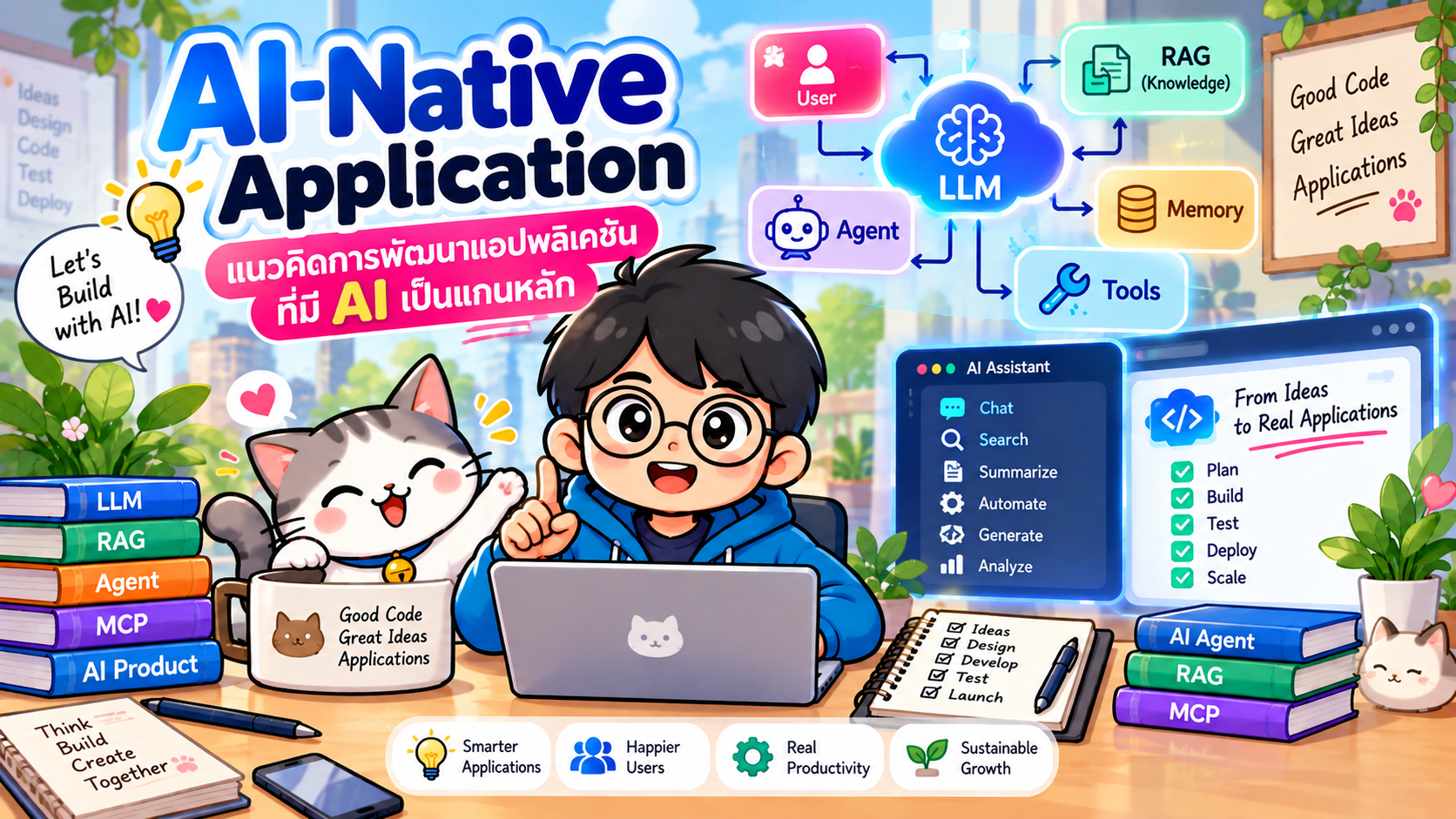
- AI-Native Application คืออะไร?
- Traditional, AI-Enabled และ AI-Native ต่างกันอย่างไร?
- AI-Native Application ออกแบบระบบโดยให้ AI เป็นส่วนหนึ่งของCore Workflow ตั้งแต่ต้น
- องค์ประกอบสำคัญของ AI-Native Application
- Multi-Agent System
- Reference Architecture
- ตัวอย่าง Technology Stack
- AI-Native เปลี่ยน Software Engineering อย่างไร?
- การทดสอบ AI-Native Application
- Observability
- Security และ Guardrails
- AI-Native ไม่ได้หมายถึงให้ AI ทำทุกอย่าง
- ตัวอย่าง AI-Native Software Engineering Platform
- แนวคิดสำคัญสำหรับการออกแบบ
- สรุป
ปัจจุบัน Generative AI และ Large Language Model (LLM) ไม่ได้ถูกนำมาใช้เพียงเพื่อสร้าง Chatbot เท่านั้น แต่เริ่มกลายเป็นส่วนสำคัญของสถาปัตยกรรมซอฟต์แวร์ ตั้งแต่การค้นหาข้อมูล การวิเคราะห์ การวางแผน การเรียกใช้ API ไปจนถึงการดำเนินงานหลายขั้นตอนผ่าน AI Agent แนวทางนี้นำไปสู่แนวคิด AI-Native Application
AI-Native Application คือแอปพลิเคชันที่ถูกออกแบบตั้งแต่ต้นให้ AI เป็นองค์ประกอบหลักของระบบ ไม่ใช่เพียงนำ AI API มาเสริมให้กับระบบเดิม ดังนั้น Business Logic บางส่วนอาจเกิดจากการทำงานร่วมกันของ Model + Prompt + Context + Retrieval + Memory + Tools + Agent Workflow
#AI-Native Application คืออะไร?
ใน Traditional Application นักพัฒนามักกำหนดพฤติกรรมของระบบด้วยโค้ดและกฎที่ค่อนข้างชัดเจน เช่น
Input
  ↓
Business Logic
  ↓
Database / API
  ↓
Output
แต่ AI-Native Application เพิ่ม AI เข้ามาเป็นส่วนหนึ่งของ Core Application Logic
User / Event
     ↓
AI Application
     ↓
Agent / Orchestrator
     ↓
LLM / Multimodal Model
     ↓
Context + RAG + Memory + Tools
     ↓
Action / Response
ระบบจึงไม่ได้เพียงประมวลผลตามกฎแบบ deterministic เท่านั้น แต่สามารถตีความภาษา วางแผน เลือกเครื่องมือ และสร้างผลลัพธ์ตามบริบทได้
#Traditional, AI-Enabled และ AI-Native ต่างกันอย่างไร?
รูปแบบ แนวคิด
Traditional Application Business Logic ส่วนใหญ่ถูกกำหนดด้วย Code และ Rules
AI-Enabled Application ระบบเดิมที่เพิ่ม AI เช่น Chatbot, Summarization หรือ Recommendation
#AI-Native Application ออกแบบระบบโดยให้ AI เป็นส่วนหนึ่งของ Core Workflow ตั้งแต่ต้น
ตัวอย่างระบบ Help Desk แบบ Traditional อาจใช้ Rule กำหนดประเภท Ticket ส่วน AI-Enabled อาจเพิ่ม Chatbot ตอบ FAQ
สำหรับ AI-Native ระบบอาจให้ Agent อ่าน Ticket ค้น Knowledge Base ตรวจข้อมูลลูกค้า วิเคราะห์ปัญหา เลือก Tool ที่เหมาะสม และสร้างคำตอบหรือดำเนินการต่อโดยมี Policy และ Guardrails ควบคุม
#องค์ประกอบสำคัญของ AI-Native Application
#1. Foundation Model
Foundation Model เช่น LLM หรือ Multimodal Model ทำหน้าที่ด้านการเข้าใจภาษา การสร้างเนื้อหา การวิเคราะห์ และการให้เหตุผล
Prompt + Context
       ↓
      LLM
       ↓
Reasoning / Generation
อย่างไรก็ตาม Production Application ไม่ควรพึ่ง Model เพียงอย่างเดียว เพราะ Model อาจไม่มีข้อมูลล่าสุดหรือข้อมูลเฉพาะขององค์กร
#2. Context Engineering
คุณภาพของ AI Application ขึ้นอยู่กับข้อมูลที่ส่งให้ Model อย่างมาก จึงเกิดแนวคิด Context Engineering
Context อาจประกอบด้วย
- System instructions
- User request
- Conversation history
- Retrieved documents
- Tool results
- User/Application state
- Policies
- Structured data
ดังนั้นการพัฒนา AI-Native Application ไม่ใช่เพียง Prompt Engineering แต่ต้องออกแบบว่า Model ควรได้รับข้อมูลอะไร เมื่อใด และมากน้อยเพียงใด
#3. Retrieval-Augmented Generation (RAG)
RAG ช่วยให้ LLM ใช้ข้อมูลภายนอกก่อนสร้างคำตอบ
User Question
      ↓
Retriever
      ↓
Knowledge Base
      ↓
Relevant Context
      ↓
LLM
      ↓
Answer
แหล่งข้อมูลสามารถเป็นเอกสาร PDF, Database, API, Source Code, Wiki หรือเอกสารภายในองค์กร
ระบบที่ซับซ้อนขึ้นอาจใช้ Hybrid Search, GraphRAG หรือ Agentic RAG
#4. Tool Calling
Tool Calling ทำให้ AI เปลี่ยนจากระบบที่เพียง ตอบคำถาม ไปเป็นระบบที่สามารถ ดำเนินการ
ตัวอย่าง Tool:
search_document()
query_database()
get_customer()
create_ticket()
send_email()
run_test()
generate_report()
ตัวอย่าง Workflow:
User
"ตรวจสอบ API production ว่ามีปัญหาหรือไม่"
          ↓
        Agent
          ↓
 ┌────────┼─────────┐
 ↓        ↓         ↓
Metrics   Logs   Health Check
 └────────┼─────────┘
          ↓
       Analysis
          ↓
       Response
#5. AI Agent
AI Agent คือองค์ประกอบที่สามารถรับ Goal วิเคราะห์สถานการณ์ เลือก Tool และดำเนินงานหลายขั้นตอน
Goal
 ↓
Understand
 ↓
Plan
 ↓
Retrieve Context
 ↓
Select Tool
 ↓
Execute
 ↓
Observe
 ↓
Reason
 ↓
Validate
 ↓
Respond
ตัวอย่าง ผู้ใช้อาจสั่งว่า
วิเคราะห์ยอดขายเดือนนี้และหาสินค้าที่มีแนวโน้มยอดขายลดลง
Agent สามารถดำเนินการเป็นลำดับ เช่น Query Database → คำนวณแนวโน้ม → เรียก Forecasting Model → เปรียบเทียบสินค้า → สร้างรายงาน
#6. Memory
AI-Native Application อาจใช้ Memory เพื่อเก็บบริบทที่จำเป็น
#Short-Term Memory
ใช้เก็บบริบทของ Session หรือ Conversation ปัจจุบัน
#Long-Term Memory
เก็บข้อมูลที่จำเป็นต่อการทำงานในอนาคต เช่น Preference หรือข้อมูลที่ได้รับอนุญาตให้จดจำ
#Episodic / Workflow Memory
เก็บเหตุการณ์หรือผลการทำงานของ Agent เพื่อใช้ประกอบ Workflow ในอนาคต
การออกแบบ Memory ต้องคำนึงถึง Privacy, Security, Data Retention และสิทธิ์การเข้าถึงข้อมูลด้วย
#7. Model Context Protocol (MCP)
MCP เป็นแนวทางสำหรับเชื่อม AI Application กับ Tools และ Data Sources ผ่าน interface ที่เป็นมาตรฐานมากขึ้น
AI Application
      ↓
    Agent
      ↓
 MCP Client
      ↓
 ┌────┼─────┬──────┐
 ↓    ↓     ↓      ↓
Git  DB   Browser  API
แนวคิดนี้ช่วยลดการสร้าง integration แบบเฉพาะสำหรับทุก Tool และทำให้เครื่องมือสามารถถูกนำกลับมาใช้กับ Agent หรือ AI Client หลายระบบได้ง่ายขึ้น
#Multi-Agent System
งานที่ซับซ้อนสามารถแบ่ง Agent ตามหน้าที่ได้ เช่น
              Supervisor Agent
                     │
       ┌─────────────┼─────────────┐
       ↓             ↓             ↓
Research Agent   Coding Agent   Testing Agent
       │             │             │
      RAG         Repository     Test Tools
ตัวอย่าง Software Engineering Workflow:
Requirement Agent
       ↓
Architecture Agent
       ↓
Coding Agent
       ↓
Testing Agent
       ↓
Security Agent
       ↓
Review Agent
       ↓
Deployment Agent
อย่างไรก็ตาม Multi-Agent ไม่จำเป็นสำหรับทุกระบบ หาก Workflow ไม่ซับซ้อน Single Agent + Tools อาจควบคุมง่ายกว่าและมีต้นทุนต่ำกว่า
#Reference Architecture
flowchart TD
    U[User / External Event] --> UI[Web / Mobile / API]
    UI --> O[Agent Orchestrator]

    O --> L[LLM / Multimodal Model]
    O --> R[RAG / Retrieval]
    O --> M[Memory]
    O --> T[Tool Layer]

    R --> V[(Vector / Search Database)]
    R --> K[(Knowledge Sources)]

    T --> MCP[MCP]
    T --> API[External APIs]
    T --> DB[(Operational Database)]
    T --> S[Enterprise Services]

    O --> G[Guardrails / Policy]
    O --> E[Evaluation]
    O --> OBS[Observability]

    E --> LOG[(Evaluation Dataset)]
    OBS --> MON[Logs / Traces / Metrics]
Architecture นี้แสดงให้เห็นว่า LLM เป็นเพียงองค์ประกอบหนึ่งของระบบ AI-Native เท่านั้น Production System ยังต้องมี Retrieval, Tools, Memory, Guardrails, Evaluation และ Observability
#ตัวอย่าง Technology Stack
Layer ตัวอย่างเทคโนโลยี
Frontend React, Next.js
Backend FastAPI, Spring Boot, Laravel, Go
Model GPT, Gemini, Claude, Llama, Qwen
Agent/Orchestration LangGraph, Google ADK, Microsoft Agent Framework
Retrieval Semantic Search, Hybrid Search, GraphRAG
Vector Store pgvector, Qdrant, Redis, Pinecone
Tool Integration REST API, Database, MCP
Observability OpenTelemetry, Langfuse, Prometheus, Grafana
#Infrastructure Docker, Kubernetes, Cloud Platform
การเป็น AI-Native ไม่ได้ขึ้นอยู่กับ Framework ใด Framework หนึ่ง แต่ขึ้นอยู่กับการออกแบบให้ AI มีบทบาทอย่างเป็นระบบใน Core Workflow
#AI-Native เปลี่ยน Software Engineering อย่างไร?
Traditional Software Development มักมีลักษณะ
Requirements
    ↓
Deterministic Logic
    ↓
Code
    ↓
Test
AI-Native Development เพิ่มองค์ประกอบใหม่
Requirements
    ↓
Agent Workflow
    ↓
Prompt + Context + Tools
    ↓
Model
    ↓
Evaluation
    ↓
Observability
    ↓
Continuous Improvement
สิ่งสำคัญคือระบบ AI มีลักษณะ probabilistic ดังนั้นการทดสอบแบบ
Expected == Actual
เพียงอย่างเดียวอาจไม่เพียงพอ
#การทดสอบ AI-Native Application
ควรพิจารณาหลายมิติ เช่น
- Response correctness
- Retrieval quality
- Groundedness
- Hallucination
- Tool-selection accuracy
- Tool-call argument correctness
- Task completion rate
- Agent trajectory
- Latency
- Token usage
- Cost
- Security
- Prompt injection resistance
- Policy compliance
ตัวอย่าง Evaluation Pipeline:
Test Dataset
     ↓
AI Application
     ↓
Generated Response / Agent Trace
     ↓
Evaluator
     ↓
Metrics
     ↓
Regression Report
Evaluation จึงควรถูกนำเข้าสู่ CI/CD เช่นเดียวกับ Unit Test และ Integration Test
#Observability
AI-Native Application ต้องตรวจสอบมากกว่า HTTP status หรือ CPU/RAM
ข้อมูลที่ควรติดตาม เช่น
Prompt
Model
Tokens
Latency
Cost
Retrieved Documents
Tool Calls
Agent Steps
Errors
Evaluation Scores
เมื่อ Agent ทำงานผิดพลาด Trace จะช่วยตอบได้ว่าปัญหาเกิดจาก Retrieval, Model, Tool, Prompt หรือ Workflow
#Security และ Guardrails
เมื่อ AI สามารถเรียก Tool ได้ ความเสี่ยงจะเพิ่มขึ้นตามสิทธิ์ของ Tool
หลักสำคัญ ได้แก่
- Least privilege
- Authentication และ Authorization
- Tool allowlist
- Input/Output validation
- Prompt injection defense
- Sensitive data protection
- Audit logging
- Human approval สำหรับ High-impact Action
ตัวอย่าง:
Agent
  ↓
Request Action
  ↓
Policy / Permission Check
  ↓
Human Approval (when required)
  ↓
Tool Execution
ไม่ควรให้ Model มีสิทธิ์ดำเนินการสำคัญโดยไม่มีชั้นควบคุมที่เหมาะสม
#AI-Native ไม่ได้หมายถึงให้ AI ทำทุกอย่าง
แนวทางที่เหมาะสมคือใช้ Hybrid Architecture
Deterministic Components
        +
Probabilistic AI Components
สิ่งที่ต้องถูกต้องแน่นอน เช่น Authentication, Authorization, Financial Calculation, Transaction Integrity หรือ Business Constraints ควรอยู่ใน deterministic code
ส่วนงานที่ AI เหมาะสม เช่น Natural Language Understanding, Classification, Summarization, Retrieval, Planning และ Content Generation สามารถมอบหมายให้ Model หรือ Agent
#ตัวอย่าง AI-Native Software Engineering Platform
สมมติสร้างระบบสำหรับพัฒนาซอฟต์แวร์จาก Requirement
User Requirement
       ↓
Requirement Agent
       ↓
Architecture Agent
       ↓
Coding Agent
       ↓
Testing Agent
       ↓
Code Review Agent
       ↓
CI/CD
       ↓
Deployment
       ↓
Observability
แต่ละ Agent สามารถใช้ Tool เช่น Git, GitHub, Test Runner, Browser Automation, Container Platform และ Monitoring API
ระบบลักษณะนี้ไม่ได้ใช้ AI เป็นเพียงผู้ช่วยเขียน Code แต่ใช้ AI เป็นส่วนหนึ่งของ Software Delivery Workflow
#แนวคิดสำคัญสำหรับการออกแบบ
ก่อนสร้าง AI-Native Application ควรถามว่า
- งานใดควรเป็น deterministic code?
- งานใดเหมาะกับ LLM?
- Model ต้องใช้ Context อะไร?
- จำเป็นต้องใช้ RAG หรือไม่?
- Agent ต้องเรียก Tool อะไร?
- Tool แต่ละตัวควรมี Permission ระดับใด?
- จำเป็นต้องมี Memory หรือไม่?
- จะประเมินคุณภาพด้วย Metric อะไร?
- จะตรวจสอบ Agent Trace อย่างไร?
- จุดใดต้องมี Human-in-the-loop?
คำถามเหล่านี้สำคัญกว่าการเริ่มต้นด้วยคำถามว่า "ควรใช้ Agent Framework ตัวไหน"
#สรุป
AI-Native Application คือการเปลี่ยนจากแนวคิด
AI = Feature
ไปเป็น
AI = Core Application Component
สถาปัตยกรรมจึงพัฒนาจาก
Frontend
   ↓
Backend
   ↓
Database
ไปสู่
Frontend / API
      ↓
AI Application Layer
      ↓
Agent / Orchestrator
      ↓
LLM / Multimodal Model
 ┌────┼───────┬────────┐
 ↓    ↓       ↓        ↓
RAG Memory   Tools  Guardrails
              ↓
        MCP / API / DB
              ↓
     External Systems
หัวใจสำคัญของระบบไม่ได้มีเพียง LLM แต่เป็นการทำงานร่วมกันของ Model + Context + RAG + Memory + Tools + Agent + MCP + Guardrails + Evaluation + Observability
ดังนั้น AI-Native Application จึงเป็นการเปลี่ยนแปลงในระดับ Software Architecture และ Software Engineering โดยนำ deterministic software มาทำงานร่วมกับ probabilistic AI อย่างมีการควบคุม ตรวจสอบ และประเมินผลได้