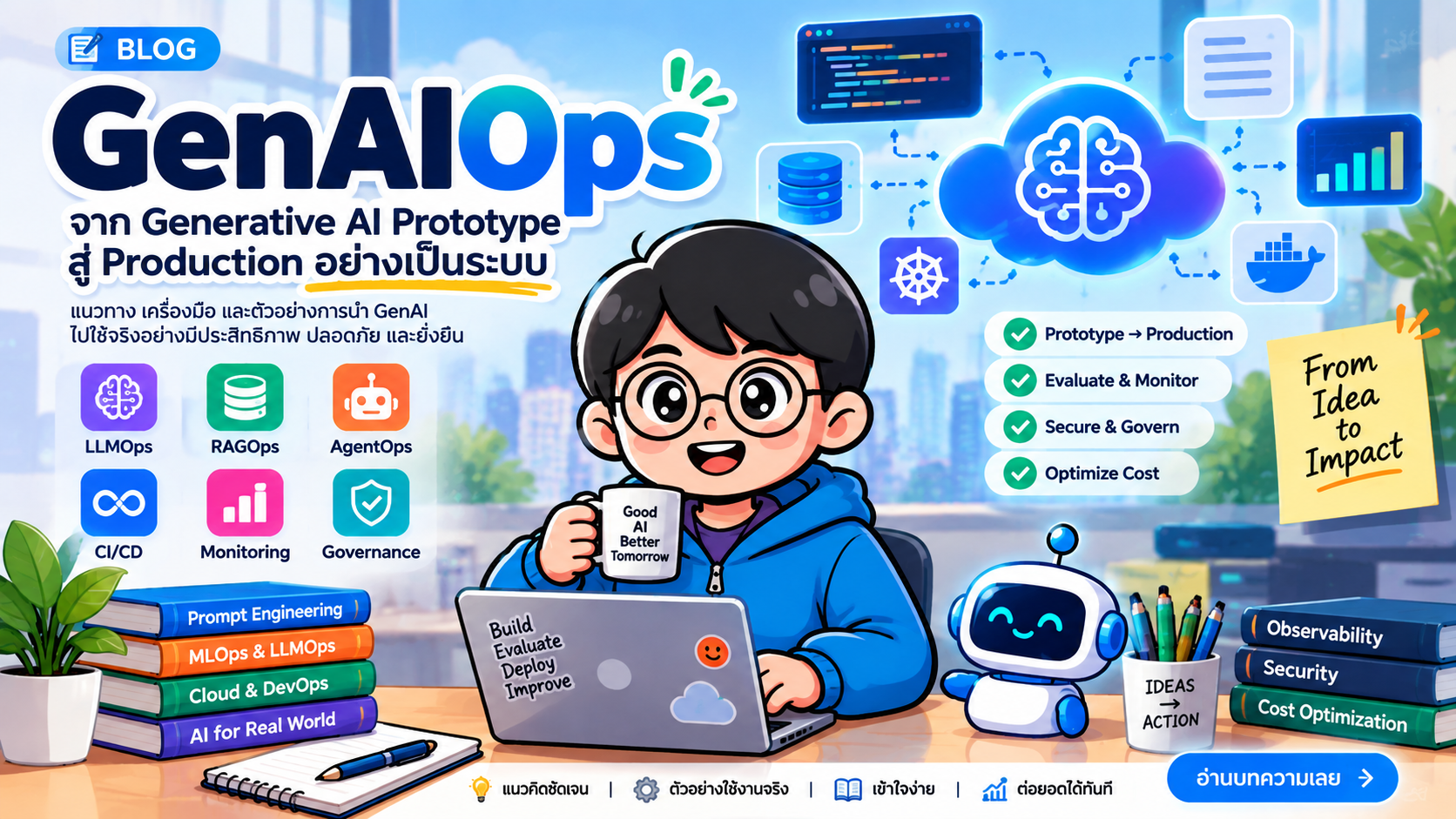
- GenAIOps: จาก Generative AI Prototype สู่ Production อย่างเป็นระบบ
- 1. GenAIOps คืออะไร
- 2. ทำไม GenAI ต้องมี Operations แบบเฉพาะ
- 3. GenAIOps Lifecycle
- 4. องค์ประกอบสำคัญของ GenAIOps
- 5. Prompt Management
- 6. RAGOps
- 7. AgentOps
- 8. Evaluation คือหัวใจของ GenAIOps
- 9. Continuous Evaluation
- 10. AI Observability
- 11. Metrics ที่ควร Monitor
- 12. Cost Observability
- 13. Security และ Guardrails
- 14. ตัวอย่าง GenAIOps Technology Stack
- 15. โครงสร้าง Project ตัวอย่าง
- 16. ตัวอย่าง CI/CD Workflow
- 17. Feedback Loop
- 18. GenAIOps กับ MLOps ต่างกันอย่างไร
- 19. GenAIOps Maturity
- 20. ภาพรวม Architecture
- 21. Best Practices
- สรุป
- แนวทางศึกษาต่อ
#GenAIOps: จาก Generative AI Prototype สู่ Production อย่างเป็นระบบ
Generative AI ในช่วงเริ่มต้นมักถูกพัฒนาในรูปแบบ Prototype เช่น Chatbot ที่เรียก LLM API, ระบบ RAG สำหรับถามตอบเอกสาร หรือ AI Agent ที่สามารถเรียกใช้เครื่องมือต่าง ๆ ได้
แต่เมื่อระบบต้องนำไปใช้งานจริงใน Production ปัญหาจะไม่ได้มีเพียงเรื่องการ Deploy Application เท่านั้น เราต้องจัดการตั้งแต่ Model, Prompt, Knowledge Base, Vector Database, Agent, Evaluation, Security, Cost, Observability ไปจนถึง Governance
แนวทางที่ใช้จัดการวงจรชีวิตเหล่านี้เรียกว่า GenAIOps (Generative AI Operations)
#1. GenAIOps คืออะไร
GenAIOps คือแนวทางด้าน Engineering และ Operations สำหรับบริหารวงจรชีวิตของระบบ Generative AI ตั้งแต่การทดลอง พัฒนา ทดสอบ ประเมินคุณภาพ Deploy เฝ้าระวัง ไปจนถึงการปรับปรุงระบบอย่างต่อเนื่อง
แนวคิดสามารถมองเป็นวิวัฒนาการได้ดังนี้
DevOps
  │
  └── MLOps
       │
       └── GenAIOps
            ├── LLMOps
            ├── RAGOps
            └── AgentOps
#DevOps
เน้นวงจรชีวิตของ Software เช่น
Code
 ↓
Build
 ↓
Test
 ↓
Deploy
 ↓
Monitor
#MLOps
เพิ่มการจัดการ Machine Learning เข้ามา เช่น
- Dataset
- Feature Engineering
- Model Training
- Experiment Tracking
- Model Registry
- Model Deployment
- Model Monitoring
#GenAIOps
เพิ่มองค์ประกอบเฉพาะของ Generative AI เช่น
- Foundation Model / LLM
- Prompt
- RAG
- Embedding Model
- Vector Database
- AI Agent
- Tools
- Memory
- Guardrails
- LLM Evaluation
- Token Usage
- Cost
- AI Observability
#2. ทำไม GenAI ต้องมี Operations แบบเฉพาะ
Traditional Application มักให้ผลลัพธ์ที่คาดการณ์ได้
Input
  ↓
Business Logic
  ↓
Deterministic Output
แต่ Generative AI มีลักษณะ probabilistic
Prompt
  ↓
LLM
  ↓
Probabilistic Output
Prompt เดียวกันอาจได้คำตอบที่แตกต่างกัน และเมื่อเปลี่ยน Model, Prompt, Context หรือ Knowledge Base คุณภาพคำตอบก็สามารถเปลี่ยนได้ทันที
ดังนั้นคำถามของทีม Production จึงไม่ได้มีเพียง
API ทำงานหรือไม่?
แต่ต้องถามเพิ่มเติมว่า
คำตอบถูกต้องหรือไม่?
คำตอบอ้างอิงข้อมูลที่ให้ไปหรือไม่?
Retrieval ค้นเอกสารที่เกี่ยวข้องหรือไม่?
Agent เลือก Tool ถูกต้องหรือไม่?
มี Hallucination หรือไม่?
Request นี้ใช้ Token และค่าใช้จ่ายเท่าใด?
สิ่งเหล่านี้คือเหตุผลที่ต้องมี GenAIOps
#3. GenAIOps Lifecycle
วงจรชีวิตหนึ่งสามารถออกแบบได้ดังนี้
Business Requirement
        │
        ▼
Data / Knowledge
        │
        ▼
Model Selection
        │
        ▼
Prompt / RAG / Agent
        │
        ▼
Experiment
        │
        ▼
Evaluation
        │
        ▼
CI/CD Pipeline
        │
        ▼
Deployment
        │
        ▼
Production
        │
        ▼
Observability
        │
        ▼
Feedback
        │
        └──────────────► Continuous Improvement
แนวคิดสำคัญคือ AI Application ต้องผ่าน Evaluation ก่อน Deploy และต้องได้รับการประเมินต่อหลัง Deploy
#4. องค์ประกอบสำคัญของ GenAIOps
#4.1 Model Management
ระบบอาจใช้ Model หลายตัว เช่น
GPT
Gemini
Claude
Llama
Qwen
Mistral
หรืออาจใช้ Model ต่างกันตามงาน
User Request
     │
     ▼
Model Router
 ┌───┼─────────┐
 ▼   ▼         ▼
LLM  VLM   Embedding
ควรเก็บข้อมูลอย่างน้อย
- Model name
- Model version
- Provider
- Temperature
- Max tokens
- Configuration
- Cost
- Latency
เพื่อให้สามารถ reproduce ผลการทดลองได้
#5. Prompt Management
Prompt ควรถูกจัดการเหมือน Source Code ไม่ควรแก้ Prompt ใน Production โดยไม่มี Version Control
ตัวอย่างโครงสร้าง
prompts/
├── system/
│   └── assistant.md
├── rag/
│   ├── answer-v1.md
│   └── answer-v2.md
└── agents/
    ├── planner.md
    └── researcher.md
Prompt ควรถูกเก็บใน Git เพื่อให้สามารถ
- Version
- Review
- Compare
- Rollback
- Test
ได้
ตัวอย่าง
Prompt v1
   │
   ├── Evaluation Score = 0.82
   │
Prompt v2
   │
   └── Evaluation Score = 0.91
จากนั้นจึงเลือก Prompt ที่เหมาะสมสำหรับ Production
#6. RAGOps
ระบบ RAG มี Pipeline เพิ่มขึ้น
Documents
    │
    ▼
Chunking
    │
    ▼
Embedding
    │
    ▼
Vector Database
    │
    ▼
Retriever
    │
    ▼
Context
    │
    ▼
LLM
    │
    ▼
Answer
ดังนั้น GenAIOps ต้องติดตามทั้ง Generation และ Retrieval
#Retrieval Metrics
ตัวอย่าง Metrics ได้แก่
- Recall@K
- Precision@K
- Hit Rate
- Mean Reciprocal Rank
- Context Relevance
#Generation Metrics
ตัวอย่างเช่น
- Answer Correctness
- Faithfulness
- Groundedness
- Relevance
- Hallucination Rate
หากคำตอบผิด จึงต้องวิเคราะห์ว่าเกิดจาก
Bad Answer
   │
   ├── Retrieval Error
   │
   ├── Poor Context
   │
   ├── Prompt Error
   │
   └── Model Error
#7. AgentOps
ระบบ Agentic AI ซับซ้อนกว่า Chatbot ปกติ เพราะ LLM สามารถตัดสินใจเรียก Tool ได้
User
 │
 ▼
Agent
 │
 ├── Search Tool
 ├── Database Tool
 ├── API Tool
 ├── Calculator
 └── Other Agent
ถ้าเป็น Multi-Agent
User
 │
 ▼
Coordinator Agent
 │
 ├── Research Agent
 ├── Database Agent
 ├── Analysis Agent
 └── Summary Agent
จึงควรติดตามเพิ่มเติม เช่น
- Agent execution path
- Tool selection
- Tool success/failure
- Number of steps
- Agent latency
- Token usage per agent
- Cost per workflow
#8. Evaluation คือหัวใจของ GenAIOps
Software ปกติมี Unit Test
Input → Expected Output
แต่ GenAI ไม่สามารถตรวจด้วย Exact Match ได้ทุกกรณี
จึงอาจใช้ Evaluation หลายระดับ
Evaluation
   │
   ├── Rule-based
   ├── Semantic Similarity
   ├── LLM-as-a-Judge
   ├── Human Evaluation
   └── Domain-specific Evaluation
ตัวอย่าง Dataset
{
  "question": "What is Kubernetes?",
  "expected": "Kubernetes is a container orchestration platform."
}
จากนั้นรันระบบ
Question
   ↓
GenAI Application
   ↓
Generated Answer
   ↓
Evaluator
   ↓
Score
ตัวอย่าง Metrics
Accuracy        0.92
Faithfulness    0.95
Relevance       0.93
Safety          0.99
#9. Continuous Evaluation
Evaluation ไม่ควรรันเฉพาะตอนพัฒนา
ควรเชื่อมเข้ากับ CI/CD
Developer
    │
    ▼
Git Push
    │
    ▼
GitHub Actions
    │
    ├── Unit Test
    ├── Integration Test
    ├── Prompt Test
    ├── RAG Evaluation
    └── Agent Evaluation
          │
          ▼
      Quality Gate
       │       │
      PASS    FAIL
       │       │
       ▼       └── Stop
    Deploy
ตัวอย่างเงื่อนไข
Faithfulness >= 0.90
Accuracy     >= 0.85
Safety       >= 0.95
ถ้าคะแนนต่ำกว่าเกณฑ์ Pipeline สามารถหยุด Deployment ได้
#10. AI Observability
Traditional Observability มักประกอบด้วย
Metrics
Logs
Traces
สำหรับ GenAI ควรเพิ่มข้อมูล เช่น
Prompt
Model
Response
Tokens
Cost
Retrieval
Tool Calls
Evaluation
Architecture ตัวอย่าง
GenAI Application
       │
       ▼
OpenTelemetry
       │
 ┌─────┼─────────┐
 ▼     ▼         ▼
Logs Metrics   Traces
       │
       ▼
 Prometheus
       │
       ▼
   Grafana
#11. Metrics ที่ควร Monitor
#Infrastructure Metrics
CPU
Memory
Network
GPU
#Application Metrics
Request Rate
Error Rate
Latency
Availability
#LLM Metrics
Prompt Tokens
Completion Tokens
Total Tokens
Model Latency
Cost
#AI Quality Metrics
Accuracy
Faithfulness
Groundedness
Relevance
Hallucination Rate
#Agent Metrics
Agent Steps
Tool Calls
Tool Failure
Agent Latency
Agent Cost
Dashboard จึงอาจแสดง
GenAI Production Dashboard

Requests/min        1,250
P95 Latency          2.4 s
Error Rate           0.8%
Avg Tokens          1,840
Cost / Request      $0.012
Faithfulness          94%
Hallucination           2%
#12. Cost Observability
Generative AI มีต้นทุนตามการใช้งาน Model
โดยประมาณ
Cost =
Input Token Cost
+
Output Token Cost
+
Embedding Cost
+
Vector DB Cost
+
Infrastructure Cost
GenAIOps จึงควรติดตาม
Cost per Request
Cost per User
Cost per Model
Cost per Agent
Cost per Workflow
ตัวอย่าง
Request
 │
 ├── Planner Agent      $0.002
 ├── Research Agent     $0.008
 ├── Analysis Agent     $0.006
 └── Summary Agent      $0.003

Total                   $0.019
ทำให้สามารถหา Agent หรือ Workflow ที่มีต้นทุนสูงผิดปกติได้
#13. Security และ Guardrails
ระบบ GenAI มี Attack Surface เพิ่มขึ้น เช่น
- Prompt Injection
- Jailbreak
- Data Leakage
- Malicious Documents
- Tool Abuse
- Sensitive Information Exposure
Architecture อาจเพิ่ม Guardrails
User
 │
 ▼
Input Guardrail
 │
 ▼
Agent / RAG / LLM
 │
 ▼
Output Guardrail
 │
 ▼
Response
รวมถึงควรใช้หลัก
- Least Privilege
- Secret Management
- Tool Permission
- Input Validation
- Output Validation
- Audit Logging
โดยเฉพาะ Agent ที่สามารถเข้าถึง Database, Cloud หรือ External API
#14. ตัวอย่าง GenAIOps Technology Stack
Stack สำหรับการทดลองหรือการอบรมสามารถเป็น
Frontend
   │
   ▼
FastAPI
   │
   ▼
LangGraph / Google ADK
   │
   ├── LLM
   │
   ├── RAG
   │     │
   │     └── Qdrant / pgvector
   │
   └── Tools
         │
         ▼
OpenTelemetry
   │
   ├── Logs
   ├── Metrics
   └── Traces
         │
         ▼
Prometheus
   │
   ▼
Grafana
CI/CD
GitHub
   │
   ▼
GitHub Actions
   │
   ├── Test
   ├── Evaluate
   ├── Security Scan
   ├── Build Image
   └── Deploy
         │
         ▼
Docker / Kubernetes
#15. โครงสร้าง Project ตัวอย่าง
genaiops-project/
│
├── app/
│   ├── api/
│   ├── agents/
│   ├── rag/
│   └── services/
│
├── prompts/
│   ├── system/
│   ├── rag/
│   └── agents/
│
├── evaluations/
│   ├── datasets/
│   ├── evaluators/
│   └── reports/
│
├── tests/
│   ├── unit/
│   ├── integration/
│   └── ai/
│
├── observability/
│   ├── prometheus/
│   └── grafana/
│
├── .github/
│   └── workflows/
│       └── genai-ci.yml
│
├── Dockerfile
├── docker-compose.yml
└── README.md
จุดสำคัญคือแยก Application, Prompt, Evaluation และ Observability ให้ชัดเจน
#16. ตัวอย่าง CI/CD Workflow
แนวคิด GitHub Actions
name: GenAI CI/CD

on:
  push:
    branches: [main]
  pull_request:

jobs:
  test:
    runs-on: ubuntu-latest

    steps:
      - uses: actions/checkout@v4

      - name: Setup Python
        uses: actions/setup-python@v5
        with:
          python-version: "3.12"

      - name: Install dependencies
        run: pip install -r requirements.txt

      - name: Run unit tests
        run: pytest tests/unit

      - name: Run integration tests
        run: pytest tests/integration

      - name: Run AI evaluation
        run: python evaluations/run.py
ใน Production จริงควรเพิ่ม Quality Gate ก่อน Build/Deploy
Test
 ↓
AI Evaluation
 ↓
Security Scan
 ↓
Quality Gate
 ↓
Build Container
 ↓
Deploy
 ↓
Smoke Test
 ↓
Production Evaluation
#17. Feedback Loop
Production Data สามารถนำกลับมาใช้ปรับปรุงระบบ
Production
   │
   ▼
Logs / Traces
   │
   ▼
Failed Cases
   │
   ▼
Evaluation Dataset
   │
   ▼
Prompt / RAG / Agent Improvement
   │
   ▼
Evaluation
   │
   ▼
Deployment
ตัวอย่างเช่นพบว่า
Question:
"อาจารย์ที่สอนวิชา Software Testing คือใคร?"

Expected:
A

Generated:
B
กรณีนี้สามารถเพิ่มเป็น Regression Dataset
evaluations/
└── datasets/
    └── regression.json
ครั้งต่อไปเมื่อเปลี่ยน Prompt, Model หรือ Retriever ระบบต้องทดสอบคำถามนี้อีกครั้ง
นี่คือแนวคิด Continuous AI Quality Improvement
#18. GenAIOps กับ MLOps ต่างกันอย่างไร
หัวข้อ MLOps GenAIOps
Model ML/DL Model Foundation Model / LLM / VLM Training สำคัญมาก อาจใช้ API Model โดยไม่ Train Dataset Training Dataset Knowledge + Evaluation Dataset Versioning Model/Data Model/Prompt/RAG/Agent Testing Accuracy/F1 Quality/Faithfulness/Safety Monitoring Drift/Performance Quality/Token/Cost/Hallucination Pipeline Train → Deploy Prompt/RAG/Agent → Evaluate → Deploy Observability Model-centric End-to-end AI workflow Operations MLOps LLMOps + RAGOps + AgentOps
#19. GenAIOps Maturity
องค์กรสามารถพัฒนาเป็นระดับต่าง ๆ
#Level 0 --- Prototype
Notebook
  ↓
LLM API
ยังไม่มี Versioning หรือ Evaluation ที่เป็นระบบ
#Level 1 --- Application
Application
   ↓
LLM
เริ่มมี API และ Deployment
#Level 2 --- CI/CD
Git
 ↓
Test
 ↓
Build
 ↓
Deploy
#Level 3 --- AI Evaluation
Git
 ↓
Test
 ↓
AI Evaluation
 ↓
Quality Gate
 ↓
Deploy
#Level 4 --- Observability
Production
 ↓
Metrics + Logs + Traces
 ↓
AI Quality Monitoring
#Level 5 --- Continuous GenAIOps
Production
   ↓
Observe
   ↓
Evaluate
   ↓
Feedback
   ↓
Improve
   ↓
Deploy
   └───────────────┐
                   ▼
                Production
#20. ภาพรวม Architecture
                     ┌─────────────────┐
                     │      User       │
                     └────────┬────────┘
                              │
                              ▼
                     ┌─────────────────┐
                     │     FastAPI     │
                     └────────┬────────┘
                              │
                              ▼
                     ┌─────────────────┐
                     │ Agent / RAG App │
                     └───────┬─────────┘
                             │
               ┌─────────────┼─────────────┐
               ▼             ▼             ▼
             LLM        Vector DB        Tools
               │             │             │
               └─────────────┼─────────────┘
                             │
                             ▼
                    ┌──────────────────┐
                    │  OpenTelemetry   │
                    └────────┬─────────┘
                             │
              ┌──────────────┼──────────────┐
              ▼              ▼              ▼
             Logs          Metrics         Traces
                              │
                              ▼
                     Prometheus / Grafana

Git
 │
 ▼
GitHub Actions
 │
 ├── Unit Test
 ├── Integration Test
 ├── AI Evaluation
 ├── Security
 └── Quality Gate
        │
        ▼
 Docker / Kubernetes
        │
        ▼
    Production
#21. Best Practices
การสร้างระบบ GenAIOps ควรเริ่มจากหลักสำคัญดังนี้
-
Version ทุกสิ่งที่มีผลต่อคำตอบ
ไม่ใช่เฉพาะ Source Code แต่รวมถึง Prompt, Model configuration, Retrieval configuration และ Evaluation Dataset -
สร้าง Evaluation Dataset ตั้งแต่เริ่มโครงการ
อย่ารอจนระบบขึ้น Production -
เพิ่ม AI Evaluation เข้า CI/CD
เพื่อป้องกัน Prompt หรือ Model ใหม่ทำให้คุณภาพลดลงโดยไม่รู้ตัว -
Trace ทุก LLM และ Tool Call
โดยเฉพาะ RAG และ Multi-Agent -
Monitor ทั้ง Reliability และ Quality
HTTP 200 ไม่ได้หมายความว่าคำตอบถูกต้อง -
ติดตาม Token และ Cost
คุณภาพที่ดีขึ้นเล็กน้อยอาจแลกกับต้นทุนที่เพิ่มขึ้นหลายเท่า -
มี Regression Test สำหรับ AI
Failed case จาก Production ควรถูกนำกลับเข้า Evaluation Dataset -
ใช้ Guardrails และ Least Privilege
โดยเฉพาะ Agent ที่สามารถเรียกใช้ Tools หรือดำเนินการกับระบบจริง
#สรุป
GenAIOps คือการนำหลักการด้าน Software Engineering, DevOps, MLOps และ AI Engineering มารวมกันเพื่อบริหารระบบ Generative AI ใน Production อย่างเป็นระบบ
หัวใจสำคัญสามารถสรุปได้เป็น
Build
  ↓
Evaluate
  ↓
Deploy
  ↓
Observe
  ↓
Improve
  ↺
ระบบ GenAI ที่ดีจึงไม่ควรมีเพียง LLM ที่ตอบคำถามได้ แต่ควรสามารถตอบคำถามเชิง Operations ได้ด้วยว่า
- ใช้ Model และ Prompt version ใด
- ใช้ Context หรือเอกสารใด
- Agent เรียก Tool อะไร
- คำตอบมีคุณภาพเพียงใด
- ใช้เวลาเท่าใด
- ใช้ Token เท่าใด
- มีค่าใช้จ่ายเท่าใด
- มีปัญหาด้าน Safety หรือไม่
- เมื่อระบบแย่ลงสามารถตรวจพบและ Rollback ได้หรือไม่
เมื่อระบบสามารถ วัดผล ตรวจสอบย้อนกลับ และปรับปรุงได้อย่างต่อเนื่อง การนำ Generative AI จาก Prototype ไปสู่ Production ก็จะมีความน่าเชื่อถือและบริหารจัดการได้มากขึ้น
#แนวทางศึกษาต่อ
หัวข้อที่สามารถต่อยอดจาก GenAIOps ได้แก่
- LLMOps
- RAGOps
- AgentOps
- LLM Evaluation
- LLM Observability
- OpenTelemetry for GenAI
- Prompt Versioning
- AI Quality Gates
- AI Security & Guardrails
- Cost Optimization
- Kubernetes for GenAI
- GitOps for AI Applications
แนวคิดสำคัญ: ในระบบ Generative AI การ Deploy ให้สำเร็จเป็นเพียงจุดเริ่มต้น สิ่งสำคัญคือเราต้องรู้ว่าระบบกำลังตอบอะไร เพราะอะไร มีคุณภาพเพียงใด และจะปรับปรุงมันอย่างปลอดภัยได้อย่างไร