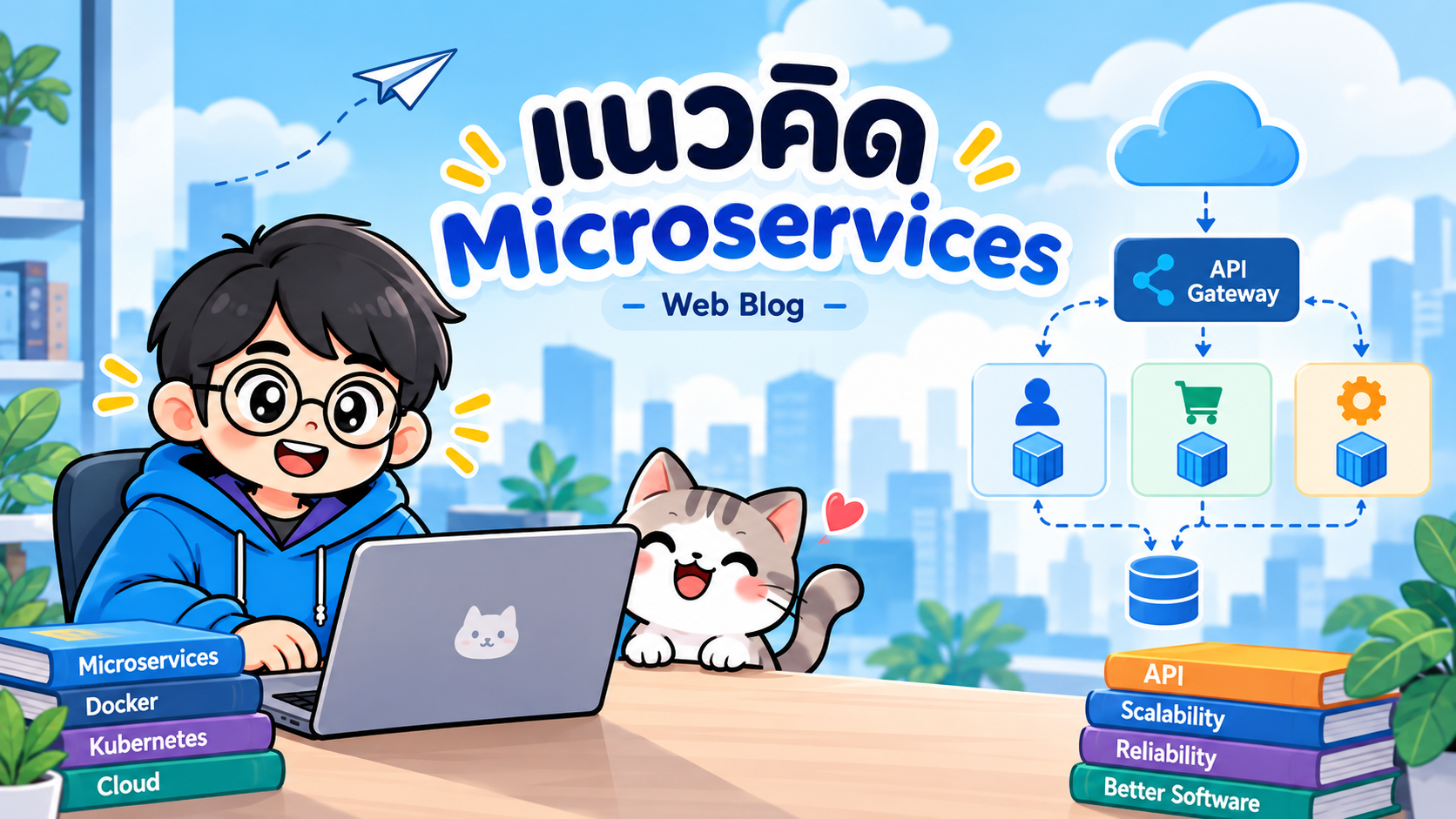
- แนวคิด Microservices
- 3. แนวคิดหลักของ Microservices
- 4. Service ควรแบ่งอย่างไร
- 5. Service Autonomy
- 6. Database per Service
- 7. การสื่อสารระหว่าง Service
- 8. API Gateway
- 9. Service Discovery
- 10. Container กับ Microservices
- 11. Kubernetes กับ Microservices
- 12. CI/CD สำหรับ Microservices
- 13. Observability
- 14. Distributed Tracing
- 15. Fault Tolerance
- 16. Circuit Breaker
- 17. Event-Driven Microservices
- 18. Saga Pattern
- 19. CQRS
- 20. Microservices Architecture ตัวอย่าง
- 21. Technology Stack ตัวอย่าง
- 22. ข้อดีของ Microservices
- 23. ข้อจำกัดของ Microservices
- 24. Modular Monolith ก่อน Microservices
- 25. Microservices Maturity
- 26. Service Mesh
- 27. Microservices Best Practices
- 28. สถาปัตยกรรมที่พบในระบบ Cloud Native
- 29. Roadmap การเรียน Microservices
- สรุป
#แนวคิด Microservices
Microservices คือแนวทางการออกแบบสถาปัตยกรรมซอฟต์แวร์ที่แบ่งระบบขนาดใหญ่ออกเป็น บริการขนาดเล็กหลายบริการ (services) โดยแต่ละบริการรับผิดชอบงานหรือความสามารถทางธุรกิจที่ชัดเจน เช่น User Service, Product Service, Order Service และ Payment Service
แนวคิดสำคัญคือ แต่ละ Service สามารถ พัฒนา ทดสอบ Deploy และขยายระบบได้อย่างอิสระ โดยสื่อสารกันผ่าน API หรือ Message Broker
#1. Microservices คืออะไร
สมมติว่าเรามีระบบ E-Commerce ซึ่งประกอบด้วยความสามารถหลายด้าน เช่น
- จัดการผู้ใช้งาน
- จัดการสินค้า
- จัดการคำสั่งซื้อ
- ชำระเงิน
- จัดส่งสินค้า
- แจ้งเตือนผู้ใช้
หากสร้างทุกอย่างไว้ใน Application เดียว จะเรียกว่า Monolithic Architecture
แต่ถ้าแยกความสามารถเหล่านี้ออกเป็น Service เช่น
User Service
Product Service
Order Service
Payment Service
Shipping Service
Notification Service
แต่ละ Service จะสามารถทำงานแยกจากกัน และมี API สำหรับติดต่อกัน
นี่คือแนวคิดของ Microservices Architecture
#2. เปรียบเทียบ Monolith กับ Microservices
#Monolithic Architecture
ระบบทั้งหมดอยู่ใน Application เดียว
+----------------------------------+
|          Web Application         |
|                                  |
|  User                            |
|  Product                         |
|  Order                           |
|  Payment                         |
|  Shipping                        |
|                                  |
+----------------------------------+
                |
             Database
ข้อดี
- เริ่มต้นง่าย
- พัฒนาได้รวดเร็วในโครงการขนาดเล็ก
- Debug และ Deploy ง่ายในช่วงแรก
- Infrastructure ไม่ซับซ้อน
ข้อจำกัดเมื่อระบบโตขึ้น
- Codebase ใหญ่
- Deploy ต้อง Deploy ทั้งระบบ
- Module หนึ่งมีปัญหาอาจกระทบทั้ง Application
- Scale บางส่วนของระบบได้ยาก
- หลายทีมทำงานพร้อมกันได้ยากขึ้น
#Microservices Architecture
ระบบถูกแบ่งออกเป็นหลาย Service
Client
   |
API Gateway
   |
   +----------------------+
   |          |           |
User      Product       Order
Service    Service      Service
   |          |           |
 User DB   Product DB   Order DB
                         |
                     Payment
                     Service
                         |
                     Payment DB
แต่ละ Service สามารถมี Database ของตัวเอง
#3. แนวคิดหลักของ Microservices
Microservices ไม่ใช่เพียงการแบ่ง API ออกเป็นหลายโปรเจกต์ แต่เป็นการออกแบบระบบโดยเน้น Service Autonomy
หลักสำคัญประกอบด้วย
- Single Business Capability
- Independent Deployment
- Database per Service
- Loose Coupling
- API Communication
- Automation
- Observability
- Fault Isolation
#4. Service ควรแบ่งอย่างไร
ควรแบ่ง Service ตาม Business Capability มากกว่าการแบ่งตาม Layer ของระบบ
ไม่ควรแบ่งแบบ
Controller Service
Repository Service
Database Service
แต่ควรแบ่งตาม Domain
User Service
Order Service
Payment Service
Inventory Service
Shipping Service
แนวคิดนี้สัมพันธ์กับ Domain-Driven Design (DDD) และ Bounded Context
ตัวอย่าง
E-Commerce
│
├── Customer Context
│   └── User Service
│
├── Catalog Context
│   └── Product Service
│
├── Order Context
│   └── Order Service
│
├── Payment Context
│   └── Payment Service
│
└── Delivery Context
    └── Shipping Service
#5. Service Autonomy
หัวใจของ Microservices คือแต่ละ Service ควรพึ่งพา Service อื่นให้น้อยที่สุด
ตัวอย่าง
Order Service
ควรสามารถ
- Build ได้เอง
- Test ได้เอง
- Deploy ได้เอง
- Scale ได้เอง
- Rollback ได้เอง
โดยไม่จำเป็นต้อง Deploy Service อื่นไปพร้อมกันทุกครั้ง
#6. Database per Service
Microservices มักใช้หลัก
One Service, One Database
ตัวอย่าง
User Service
   |
User Database

Product Service
   |
Product Database

Order Service
   |
Order Database
ไม่ควรให้หลาย Service เข้าถึง Database เดียวกันโดยตรง
ตัวอย่างที่ควรหลีกเลี่ยง
User Service -----+
                  |
Order Service ----+---- Shared Database
                  |
Payment Service --+
เพราะทำให้เกิด Tight Coupling
แนวทางที่เหมาะสมคือ Service อื่นต้องเรียกผ่าน API หรือ Event
#7. การสื่อสารระหว่าง Service
Microservices มีรูปแบบการสื่อสารหลัก 2 แบบ
#7.1 Synchronous Communication
เช่น
- REST API
- gRPC
ตัวอย่าง
Order Service
     |
     | REST API
     v
Payment Service
ตัวอย่าง REST API
POST /payments
Content-Type: application/json

{
  "orderId": 1001,
  "amount": 2500
}
เหมาะกับงานที่ต้องการผลลัพธ์ทันที
#7.2 Asynchronous Communication
ใช้ Message Broker เช่น
- Apache Kafka
- RabbitMQ
- Amazon SQS
- NATS
ตัวอย่าง
Order Service
     |
     | OrderCreated Event
     v
Kafka
  |
  +----------+-----------+
  |          |           |
Payment   Shipping   Notification
Service   Service      Service
ข้อดี
- ลด Coupling
- รองรับโหลดสูง
- Service ไม่จำเป็นต้องออนไลน์พร้อมกัน
- เหมาะกับ Event-Driven Architecture
#8. API Gateway
หาก Client ต้องเรียก Service จำนวนมากโดยตรง ระบบจะซับซ้อน
เช่น
Frontend
 ├── User Service
 ├── Product Service
 ├── Order Service
 └── Payment Service
จึงนิยมใช้ API Gateway
Frontend
   |
API Gateway
   |
   +----------+----------+----------+
   |          |          |          |
 User      Product     Order      Payment
Service    Service    Service     Service
หน้าที่ของ API Gateway เช่น
- Routing
- Authentication
- Rate Limiting
- Request Logging
- Load Balancing
- API Aggregation
เครื่องมือที่นิยม เช่น
- Kong
- NGINX
- Traefik
- Spring Cloud Gateway
- AWS API Gateway
#9. Service Discovery
ในระบบ Kubernetes หรือ Cloud Service อาจเปลี่ยน IP Address ได้ตลอดเวลา
ดังนั้นจึงต้องมี Service Discovery
ตัวอย่าง
Order Service
     |
     | lookup
     v
Service Registry
     |
     v
Payment Service
เครื่องมือที่เกี่ยวข้อง เช่น
- Kubernetes Service
- Consul
- Eureka
ใน Kubernetes มี Service Discovery ผ่าน DNS อยู่แล้ว เช่น
payment-service.default.svc.cluster.local
#10. Container กับ Microservices
Microservices มักทำงานร่วมกับ Container เช่น Docker
ตัวอย่าง
User Service
   |
Docker Container

Order Service
   |
Docker Container

Payment Service
   |
Docker Container
ข้อดี
- Environment เหมือนกัน
- Deploy ง่าย
- Scale ง่าย
- รองรับ CI/CD
#11. Kubernetes กับ Microservices
เมื่อมี Microservices จำนวนมาก การจัดการ Container จะซับซ้อน
Kubernetes ช่วยจัดการ
- Deployment
- Scaling
- Load Balancing
- Service Discovery
- Rolling Update
- Self Healing
ตัวอย่าง
Kubernetes Cluster
│
├── user-service
│   ├── pod
│   └── pod
│
├── order-service
│   ├── pod
│   └── pod
│
└── payment-service
    ├── pod
    └── pod
#12. CI/CD สำหรับ Microservices
แต่ละ Service ควรมี Pipeline ของตัวเอง
ตัวอย่าง
Developer
   |
Git Push
   |
GitHub Actions
   |
Unit Test
   |
Build Docker Image
   |
Push Registry
   |
Deploy Kubernetes
ตัวอย่างโครงสร้าง Repository
services/
├── user-service/
│   ├── Dockerfile
│   └── .github/workflows/deploy.yml
│
├── order-service/
│   ├── Dockerfile
│   └── .github/workflows/deploy.yml
│
└── payment-service/
    ├── Dockerfile
    └── .github/workflows/deploy.yml
#13. Observability
ระบบ Microservices มี Service จำนวนมาก ดังนั้น Monitoring จึงสำคัญ
Observability มักประกอบด้วย 3 ส่วน
Metrics
Logs
Traces
เครื่องมือที่นิยม
#Metrics
Prometheus
Grafana
#Logging
ELK Stack
Loki
#Distributed Tracing
Jaeger
Zipkin
OpenTelemetry
#14. Distributed Tracing
ตัวอย่าง Request
Client
  |
API Gateway
  |
Order Service
  |
Payment Service
  |
Bank API
หากเกิด Error เราต้องทราบว่า Error เกิดที่ Service ใด
Distributed Tracing จะช่วยสร้าง Trace
Trace ID: abc123

API Gateway       20 ms
Order Service     50 ms
Payment Service   80 ms
Bank API         500 ms
ทำให้สามารถวิเคราะห์ Performance ได้ง่ายขึ้น
#15. Fault Tolerance
ระบบ Microservices ต้องออกแบบให้รองรับ Failure
ตัวอย่าง
Order Service
     |
Payment Service
หาก Payment Service ไม่ตอบสนอง
Order Service ไม่ควรค้างไปตลอด
จึงนิยมใช้ Pattern เช่น
- Timeout
- Retry
- Circuit Breaker
- Bulkhead
- Fallback
#16. Circuit Breaker
Circuit Breaker ช่วยป้องกัน Service เรียก Service ที่กำลังมีปัญหาซ้ำ ๆ
ตัวอย่าง
Order Service
      |
Circuit Breaker
      |
Payment Service
สถานะทั่วไป
CLOSED
   |
Failure
   |
OPEN
   |
Timeout
   |
HALF-OPEN
Library ที่ใช้ได้ เช่น
Resilience4j
Polly
#17. Event-Driven Microservices
ระบบ Microservices มักใช้ Event
ตัวอย่าง
Customer Order
     |
Order Service
     |
OrderCreated
     |
Kafka
 ├── Payment Service
 ├── Inventory Service
 └── Notification Service
Event ตัวอย่าง
{
  "event": "OrderCreated",
  "orderId": 1001,
  "customerId": 45,
  "total": 2500
}
#18. Saga Pattern
Microservices ไม่สามารถใช้ Transaction แบบ Database เดียวได้ง่าย
เช่นกระบวนการสั่งซื้อ
Create Order
     |
Reserve Product
     |
Payment
     |
Shipping
หาก Payment ล้มเหลว ต้อง Rollback
จึงใช้ Saga Pattern
ตัวอย่าง
Order Created
     |
Inventory Reserved
     |
Payment Failed
     |
Cancel Inventory
     |
Cancel Order
#19. CQRS
CQRS ย่อมาจาก
Command Query Responsibility Segregation
แยกการทำงานออกเป็น
Command
Create / Update / Delete
และ
Query
Read
ตัวอย่าง
Command API
    |
Write Database

Query API
    |
Read Database
เหมาะกับระบบที่มี Read และ Write Pattern แตกต่างกันมาก
#20. Microservices Architecture ตัวอย่าง
ตัวอย่างระบบ E-Commerce
flowchart LR

Client --> Gateway[API Gateway]

Gateway --> User[User Service]
Gateway --> Product[Product Service]
Gateway --> Order[Order Service]

Order --> Payment[Payment Service]
Order --> Kafka[Kafka]

Kafka --> Shipping[Shipping Service]
Kafka --> Notify[Notification Service]

User --> UserDB[(User DB)]
Product --> ProductDB[(Product DB)]
Order --> OrderDB[(Order DB)]
Payment --> PaymentDB[(Payment DB)]
#21. Technology Stack ตัวอย่าง
Frontend
React
Next.js
Vue
Angular
Backend
Spring Boot
Node.js
Go
.NET
Laravel
FastAPI
API
REST
GraphQL
gRPC
Message Broker
Kafka
RabbitMQ
NATS
Database
PostgreSQL
MySQL
MongoDB
Redis
Container
Docker
Orchestration
Kubernetes
CI/CD
GitHub Actions
GitLab CI
Jenkins
Argo CD
Monitoring
Prometheus
Grafana
OpenTelemetry
#22. ข้อดีของ Microservices
#Independent Deployment
สามารถ Deploy Service แยกกันได้
Update Payment Service

ไม่จำเป็นต้อง Deploy

User Service
Product Service
Order Service
#Independent Scaling
สามารถ Scale เฉพาะ Service ที่โหลดสูง
Product Service

2 Pods
   ↓
20 Pods
โดย Service อื่นไม่ต้อง Scale ตาม
#Technology Flexibility
แต่ละ Service สามารถเลือก Technology ต่างกันได้
User Service
Spring Boot

Payment Service
Go

Recommendation Service
Python

Notification Service
Node.js
แต่ควรควบคุมไม่ให้เกิด Technology Sprawl มากเกินไป
#23. ข้อจำกัดของ Microservices
Microservices เพิ่มความซับซ้อนในหลายด้าน
เช่น
Network
Deployment
Monitoring
Security
Testing
Distributed Transaction
Service Discovery
ปัญหาที่พบบ่อย
- Network Failure
- Distributed Transaction
- Debug ยาก
- Infrastructure ซับซ้อน
- Logging กระจายหลาย Service
- DevOps มีภาระมากขึ้น
ดังนั้น Microservices ไม่ใช่คำตอบที่เหมาะกับทุกระบบ
#24. Modular Monolith ก่อน Microservices
สำหรับโครงการใหม่ หลายกรณีควรเริ่มจาก
Modular Monolith
ก่อน
Microservices
ตัวอย่าง
Application
│
├── User Module
├── Product Module
├── Order Module
└── Payment Module
เมื่อระบบเติบโตจึงค่อยแยก Module บางส่วนออกเป็น Service
ตัวอย่าง
Application
│
├── User Module
├── Product Module
└── Order Module

Payment Module
      ↓
Payment Microservice
แนวทางนี้ช่วยลดความซับซ้อนในช่วงเริ่มต้น
#25. Microservices Maturity
การพัฒนา Microservices มักเติบโตตามลำดับ
Monolith
   |
Modular Monolith
   |
Microservices
   |
Container
   |
Kubernetes
   |
CI/CD
   |
Observability
   |
Service Mesh
#26. Service Mesh
เมื่อ Microservices มีจำนวนมาก อาจใช้ Service Mesh
เช่น
Istio
Linkerd
ช่วยจัดการ
- Service-to-Service Communication
- mTLS
- Traffic Management
- Retry
- Circuit Breaking
- Observability
ตัวอย่าง
Service A
   |
Sidecar Proxy
   |
Service Mesh
   |
Sidecar Proxy
   |
Service B
#27. Microservices Best Practices
แนวทางที่ควรใช้
Design Around Business Domain
Database per Service
API First
Automated Testing
CI/CD
Observability
Containerization
Infrastructure as Code
Fault Tolerance
Zero Trust Security
#28. สถาปัตยกรรมที่พบในระบบ Cloud Native
ระบบสมัยใหม่มักมีโครงสร้าง
Users
  |
CDN
  |
Load Balancer
  |
API Gateway
  |
Microservices
  |
Kafka
  |
Databases
  |
Kubernetes
  |
Cloud Infrastructure
โดยมี
CI/CD
Monitoring
Logging
Tracing
Security
ทำงานร่วมกัน
#29. Roadmap การเรียน Microservices
ลำดับการเรียนที่แนะนำ
1. REST API
       ↓
2. Docker
       ↓
3. Microservices Design
       ↓
4. API Gateway
       ↓
5. Service Discovery
       ↓
6. Message Broker
       ↓
7. Kubernetes
       ↓
8. CI/CD
       ↓
9. Observability
       ↓
10. Event-Driven Architecture
#สรุป
Microservices คือแนวทางการออกแบบระบบโดยแยก Application ออกเป็น Service ขนาดเล็กหลาย Service แต่ละ Service รับผิดชอบ Business Capability ของตัวเอง
หัวใจสำคัญคือ
Independent Service
Independent Deployment
Independent Database
Loose Coupling
API Communication
Automation
Observability
Fault Tolerance
Microservices เหมาะกับระบบที่
- มีขนาดใหญ่
- มีหลายทีมพัฒนา
- ต้อง Scale สูง
- ต้อง Deploy บ่อย
- ต้องการแยกความรับผิดชอบของแต่ละ Domain
แต่ Microservices มีต้นทุนด้าน Infrastructure และ Distributed System สูง
ดังนั้นสำหรับระบบขนาดเล็ก ควรพิจารณาเริ่มจาก
Modular Monolith
แล้วค่อยพัฒนาไปสู่
Microservices
เมื่อระบบและทีมมีความซับซ้อนมากขึ้น
#Architecture Journey
Monolith
   ↓
Modular Monolith
   ↓
Microservices
   ↓
Docker
   ↓
Kubernetes
   ↓
CI/CD
   ↓
Observability
   ↓
Cloud Native
แนวคิดสำคัญที่สุดของ Microservices ไม่ใช่การทำให้ระบบมี Service จำนวนมาก แต่คือ
การออกแบบแต่ละ Service ให้มีขอบเขตชัดเจน พึ่งพากันให้น้อย และสามารถเปลี่ยนแปลงหรือ Deploy ได้อย่างอิสระ