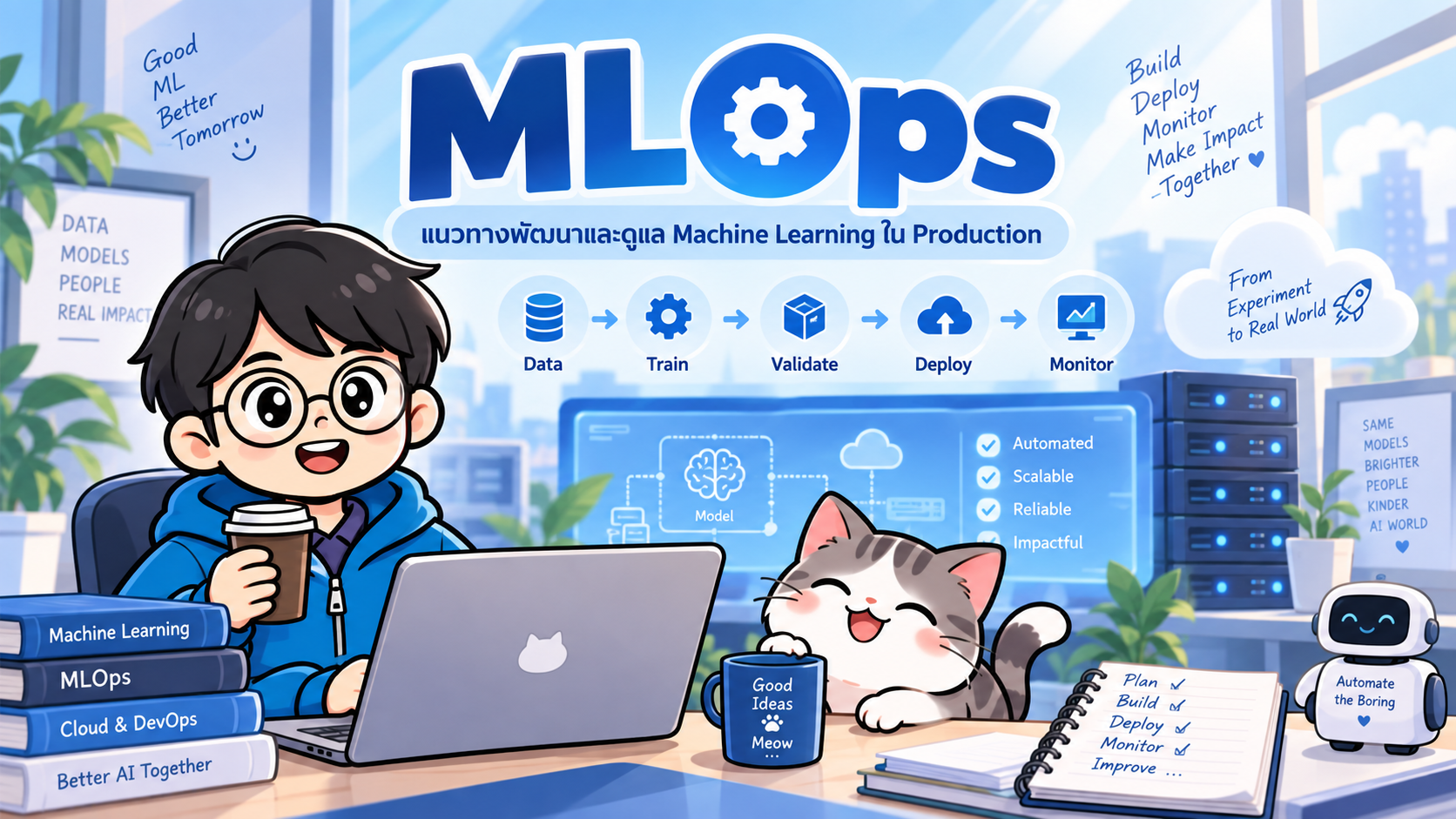
- บทนำ
- ทำไมต้องมี MLOps
- MLOps Lifecycle
- 4. Model Training
- 5. Experiment Tracking
- MLflow
- 6. Model Registry
- 7. Model Deployment
- ตัวอย่าง FastAPI สำหรับ Model Serving
- Dockerize ML Model
- 8. CI/CD สำหรับ Machine Learning
- ตัวอย่าง GitHub Actions
- 9. Model Monitoring
- เครื่องมือ Monitoring
- MLOps Architecture
- ตัวอย่าง Technology Stack
- ตัวอย่าง MLOps Pipeline
- MLOps Maturity Levels
- Automated Retraining
- Machine Learning Testing
- MLOps กับ DevOps ต่างกันอย่างไร
- CI / CD / CT
- MLOps กับ Kubernetes
- ตัวอย่าง Project Structure
- แนวทางเริ่มต้น MLOps
- Roadmap การเรียนรู้ MLOps
- MLOps บน Cloud
- Best Practices
- สรุป
#บทนำ
MLOps (Machine Learning Operations) คือแนวทางที่ผสานแนวคิดจาก Machine Learning, Data Engineering, DevOps และ Software Engineering เพื่อทำให้การพัฒนาโมเดล Machine Learning สามารถนำขึ้นใช้งานจริง ดูแล ปรับปรุง และตรวจสอบได้อย่างเป็นระบบ
เป้าหมายของ MLOps ไม่ใช่เพียงการสร้างโมเดลที่มีค่า Accuracy สูง แต่ต้องทำให้โมเดลสามารถทำงานในระบบ Production ได้อย่าง เชื่อถือได้ ทำซ้ำได้ ตรวจสอบได้ และปรับปรุงได้ต่อเนื่อง
#ทำไมต้องมี MLOps
ในงาน Machine Learning แบบทดลอง เราอาจทำงานใน Notebook แล้วได้โมเดลที่ดี แต่เมื่อจะนำไปใช้งานจริงจะพบปัญหาหลายด้าน เช่น
- Dataset เปลี่ยนไปจากตอนฝึกโมเดล
- Feature ที่ใช้ตอน Train และตอน Predict ไม่ตรงกัน
- ไม่ทราบว่าโมเดล Version ใดกำลังถูกใช้งาน
- ไม่สามารถย้อนกลับไปยังโมเดล Version ก่อนหน้าได้
- โมเดลมี Accuracy ลดลงเมื่อเวลาผ่านไป
- Pipeline Train ไม่สามารถทำซ้ำได้
- การ Deploy โมเดลต้องทำด้วยมือ
- ไม่มีระบบ Monitoring สำหรับตรวจสอบ Prediction
MLOps จึงเข้ามาช่วยจัดการวงจรชีวิตของ Machine Learning ตั้งแต่ต้นจนจบ
#MLOps Lifecycle
วงจรการทำงานของ MLOps สามารถแบ่งเป็นขั้นตอนหลักดังนี้
Data Collection
      ↓
Data Validation
      ↓
Feature Engineering
      ↓
Model Training
      ↓
Model Evaluation
      ↓
Model Registry
      ↓
Deployment
      ↓
Monitoring
      ↓
Retraining
#1. Data Collection
เริ่มต้นจากการรวบรวมข้อมูลจากแหล่งต่าง ๆ เช่น
- Database
- Data Warehouse
- Data Lake
- REST API
- IoT Device
- Log File
- Streaming Data
ตัวอย่างเครื่องมือ
- Apache Kafka
- Apache Airflow
- dbt
- AWS Glue
- Google Cloud Dataflow
- Azure Data Factory
#2. Data Validation
ก่อนนำข้อมูลไป Train Model ควรตรวจสอบคุณภาพข้อมูล เช่น
- Missing Value
- Duplicate Data
- Invalid Data Type
- Outlier
- Schema Change
- Distribution Shift
เครื่องมือที่นิยมใช้ เช่น
- Great Expectations
- Pandera
- TensorFlow Data Validation
ตัวอย่างด้วย Pandera
import pandera as pa
from pandera import Column, DataFrameSchema

schema = DataFrameSchema({
    "age": Column(int, pa.Check.ge(0)),
    "income": Column(float, pa.Check.ge(0)),
})

validated_df = schema.validate(df)
#3. Feature Engineering
Feature Engineering คือการแปลงข้อมูลให้เหมาะสมกับโมเดล เช่น
Raw Data
   ↓
Cleaning
   ↓
Normalization
   ↓
Encoding
   ↓
Feature Selection
ตัวอย่าง Feature
age
income
transaction_count
average_purchase
customer_tenure
ในระบบขนาดใหญ่สามารถใช้ Feature Store เพื่อให้ Training และ Prediction ใช้ Feature เดียวกัน
ตัวอย่างเครื่องมือ
- Feast
- Tecton
- Hopsworks
#4. Model Training
ขั้นตอนนี้คือการ Train Machine Learning Model
ตัวอย่างด้วย Scikit-learn
from sklearn.ensemble import RandomForestClassifier

model = RandomForestClassifier(
    n_estimators=100,
    random_state=42
)

model.fit(X_train, y_train)
แต่ใน MLOps ควรบันทึกข้อมูลการทดลองด้วย
Model Version
Parameters
Metrics
Dataset Version
Source Code Version
#5. Experiment Tracking
Experiment Tracking ช่วยบันทึกผลการทดลองแต่ละครั้ง
ตัวอย่าง
| Run | Model | Accuracy | Learning Rate |
|---|---|---|---|
| 001 | Random Forest | 0.91 | - |
| 002 | XGBoost | 0.94 | 0.10 |
| 003 | XGBoost | 0.95 | 0.05 |
เครื่องมือยอดนิยม
- MLflow
- Weights & Biases
- Neptune
- Comet
#MLflow
MLflow เป็นเครื่องมือ Open Source สำหรับจัดการ Machine Learning Lifecycle
องค์ประกอบหลัก ได้แก่
MLflow Tracking
MLflow Projects
MLflow Models
MLflow Model Registry
ตัวอย่างติดตั้ง
pip install mlflow
เริ่ม MLflow Server
mlflow server --host 0.0.0.0 --port 5000
เปิด Browser
http://localhost:5000
ตัวอย่างบันทึก Experiment
import mlflow

with mlflow.start_run():

    mlflow.log_param(
        "n_estimators",
        100
    )

    mlflow.log_metric(
        "accuracy",
        0.95
    )

    mlflow.sklearn.log_model(
        model,
        "model"
    )
#6. Model Registry
Model Registry ใช้จัดการ Version ของ Model
ตัวอย่าง
Model
│
├── Version 1
│
├── Version 2
│
└── Version 3
Model อาจมีสถานะ เช่น
Development
Staging
Production
Archived
ข้อดีคือสามารถ
- Version Model
- Rollback
- Track History
- Promote Model
- Audit Model
#7. Model Deployment
โมเดลสามารถ Deploy ได้หลายรูปแบบ
#Batch Prediction
เหมาะสำหรับ
Prediction รายวัน
Recommendation
Risk Scoring
Report Generation
ตัวอย่าง
Database
   ↓
Batch Job
   ↓
ML Model
   ↓
Prediction
   ↓
Database
#Real-time Prediction
เหมาะสำหรับงานที่ต้องตอบกลับทันที
Client
  ↓
REST API
  ↓
ML Model
  ↓
Prediction
Framework ที่นิยมใช้
- FastAPI
- Flask
- BentoML
- KServe
- Seldon
#ตัวอย่าง FastAPI สำหรับ Model Serving
ติดตั้ง
pip install fastapi uvicorn joblib
สร้างไฟล์
app.py
ตัวอย่าง
from fastapi import FastAPI
import joblib

app = FastAPI()

model = joblib.load(
    "model.pkl"
)

@app.get("/")
def root():

    return {
        "message": "ML API"
    }


@app.post("/predict")
def predict(
    age: int,
    income: float
):

    result = model.predict([
        [
            age,
            income
        ]
    ])

    return {
        "prediction":
        int(result[0])
    }
Run
uvicorn app:app --host 0.0.0.0 --port 8000
เปิด Swagger UI
http://localhost:8000/docs
#Dockerize ML Model
สร้าง
Dockerfile
ตัวอย่าง
FROM python:3.13-slim

WORKDIR /app

COPY . .

RUN pip install     fastapi     uvicorn     scikit-learn     joblib

CMD [
    "uvicorn",
    "app:app",
    "--host",
    "0.0.0.0",
    "--port",
    "8000"
]
Build
docker build -t ml-api .
Run
docker run -p 8000:8000 ml-api
#8. CI/CD สำหรับ Machine Learning
CI/CD ช่วยทำ Automation ให้ Pipeline
ตัวอย่าง Workflow
Push Code
   ↓
Run Test
   ↓
Data Validation
   ↓
Train Model
   ↓
Evaluate Model
   ↓
Build Docker Image
   ↓
Deploy
#ตัวอย่าง GitHub Actions
name: ML Pipeline

on:
  push:
    branches:
      - main

jobs:

  test:

    runs-on: ubuntu-latest

    steps:

      - uses: actions/checkout@v4

      - uses: actions/setup-python@v5
        with:
          python-version: "3.13"

      - run: |
          pip install -r requirements.txt

      - run: |
          pytest
สามารถเพิ่มขั้นตอน Train Model
- name: Train Model
  run: |
    python train.py
#9. Model Monitoring
เมื่อ Deploy Model แล้วต้อง Monitoring
ควรตรวจสอบ
Prediction Accuracy
Latency
Error Rate
Data Drift
Model Drift
Resource Usage
#Data Drift
Data Drift คือ Distribution ของ Input เปลี่ยนไป
ตัวอย่าง
Training Data

Age = 20-40

Production Data

Age = 40-70
Model อาจ Predict ผิดมากขึ้น
#Concept Drift
Concept Drift คือความสัมพันธ์ระหว่าง Input และ Output เปลี่ยนไป
ตัวอย่าง
พฤติกรรมลูกค้าเปลี่ยน

Economic Condition เปลี่ยน

Fraud Pattern เปลี่ยน
#เครื่องมือ Monitoring
ตัวอย่างเครื่องมือ
- Evidently
- Prometheus
- Grafana
- WhyLabs
- Arize
- Fiddler
#MLOps Architecture
ตัวอย่าง Architecture
Data Source
    │
    ▼
Data Pipeline
    │
    ▼
Feature Store
    │
    ▼
Training Pipeline
    │
    ▼
Experiment Tracking
    │
    ▼
Model Registry
    │
    ▼
CI/CD
    │
    ▼
Model Serving
    │
    ▼
Monitoring
#ตัวอย่าง Technology Stack
#Data
PostgreSQL
Kafka
S3
BigQuery
#Pipeline
Airflow
Dagster
Prefect
#Experiment Tracking
MLflow
Weights & Biases
#Feature Store
Feast
#Container
Docker
#Orchestration
Kubernetes
#CI/CD
GitHub Actions
GitLab CI
Jenkins
#Monitoring
Prometheus
Grafana
Evidently
#ตัวอย่าง MLOps Pipeline
GitHub

  ↓

GitHub Actions

  ↓

Run Tests

  ↓

Train Model

  ↓

MLflow

  ↓

Model Registry

  ↓

Docker Image

  ↓

Container Registry

  ↓

Kubernetes

  ↓

FastAPI

  ↓

Prometheus

  ↓

Grafana
#MLOps Maturity Levels
องค์กรสามารถพัฒนา MLOps ตามระดับได้
#Level 0 — Manual ML
Notebook

Train Model

Manual Deploy
เหมาะสำหรับ
Prototype
Research
Experiment
#Level 1 — Automated Training
มี Pipeline
Data

↓

Train

↓

Evaluate

↓

Deploy
#Level 2 — CI/CD Pipeline
เพิ่ม
Version Control
Testing
CI/CD
Model Registry
Monitoring
#Level 3 — Full MLOps Platform
มีระบบ
Feature Store

Experiment Tracking

Model Registry

Automated Retraining

Model Monitoring

Data Drift Detection
#Automated Retraining
ตัวอย่าง Workflow
Monitoring

↓

Detect Drift

↓

Trigger Training

↓

Evaluate New Model

↓

Compare Model

↓

Deploy

↓

Monitor
แนวทางนี้ช่วยให้โมเดลสามารถปรับตัวตามข้อมูลใหม่ได้
#Machine Learning Testing
MLOps ควรมี Testing หลายระดับ
#Data Test
ตรวจสอบ
Schema
Missing Data
Distribution
Data Type
#Model Test
ตรวจสอบ
Accuracy
Precision
Recall
F1 Score
#API Test
ตรวจสอบ
HTTP Status

Response Schema

Latency
#Integration Test
ตรวจสอบ
Model

API

Database

Pipeline
#MLOps กับ DevOps ต่างกันอย่างไร
| DevOps | MLOps |
|---|---|
| Application | ML Model |
| Source Code | Code + Data |
| Build Software | Train Model |
| Software Version | Model Version |
| Application Monitoring | Model Monitoring |
| CI/CD | CI/CD/CT |
| Code Testing | Code + Data + Model Testing |
ใน MLOps มีแนวคิดเพิ่มคือ
CT
Continuous Training
#CI / CD / CT
#Continuous Integration
Code
↓
Test
↓
Build
#Continuous Delivery
Build
↓
Deploy
#Continuous Training
New Data
↓
Retrain
↓
Evaluate
↓
Deploy New Model
#MLOps กับ Kubernetes
Kubernetes เหมาะสำหรับ
Model Serving

Scaling

Rolling Update

Load Balancing

Resource Management
ตัวอย่าง Architecture
Client

↓

Ingress

↓

Kubernetes Service

↓

FastAPI Pod

↓

ML Model
เมื่อ Load เพิ่ม
Pod × 1

↓

Pod × 5
สามารถใช้ Horizontal Pod Autoscaler
#ตัวอย่าง Project Structure
mlops-project

├── data
│
├── notebooks
│
├── src
│   ├── train.py
│   └── predict.py
│
├── tests
│
├── models
│
├── app
│   └── main.py
│
├── Dockerfile
│
├── requirements.txt
│
├── .github
│   └── workflows
│       └── ml.yml
│
└── README.md
#แนวทางเริ่มต้น MLOps
สำหรับผู้เริ่มต้นสามารถเริ่มด้วย Stack
Python
+
Scikit-learn
+
MLflow
+
FastAPI
+
Docker
+
GitHub Actions
จากนั้นค่อยเพิ่ม
Kubernetes

Feature Store

Airflow

Monitoring
#Roadmap การเรียนรู้ MLOps
1 Python

2 Machine Learning

3 Git

4 Docker

5 FastAPI

6 MLflow

7 CI/CD

8 Kubernetes

9 Monitoring

10 Cloud MLOps
#MLOps บน Cloud
Cloud Provider มีบริการ MLOps Platform
#AWS
Amazon SageMaker
รองรับ
Training
Model Registry
Model Endpoint
Pipeline
Monitoring
#Google Cloud
Vertex AI
รองรับ
Training
Model Registry
Pipeline
Endpoint
Feature Store
#Microsoft Azure
Azure Machine Learning
รองรับ
Experiment
Pipeline
Model Registry
Deployment
Monitoring
#Best Practices
แนวทางที่ควรใช้ใน MLOps
- Version ทั้ง Code, Data และ Model
- สร้าง Pipeline ที่ Reproducible
- แยก Training และ Serving Environment
- ใช้ Model Registry
- ทำ Automated Testing
- ใช้ CI/CD
- Monitor Data Drift และ Model Drift
- เก็บ Metrics ทุก Experiment
- รองรับ Rollback
- ใช้ Infrastructure as Code
#สรุป
MLOps คือแนวทางสำคัญสำหรับการนำ Machine Learning ไปใช้งานจริงใน Production อย่างมีระบบ
หัวใจของ MLOps คือ
Automation

Reproducibility

Versioning

Testing

Deployment

Monitoring

Continuous Training
Architecture ที่พบได้บ่อยคือ
Data
 ↓
Training
 ↓
Experiment Tracking
 ↓
Model Registry
 ↓
CI/CD
 ↓
Deployment
 ↓
Monitoring
 ↓
Retraining
สำหรับผู้เริ่มต้นสามารถเริ่มจาก
Python

Scikit-learn

MLflow

FastAPI

Docker

GitHub Actions
แล้วจึงขยายระบบด้วย
Kubernetes

Airflow

Feature Store

Prometheus

Grafana

Cloud MLOps Platform
MLOps ทำให้ Machine Learning เปลี่ยนจากงานทดลองใน Notebook ไปสู่ ระบบ Production ที่สามารถดูแล ตรวจสอบ และพัฒนาได้อย่างต่อเนื่อง